

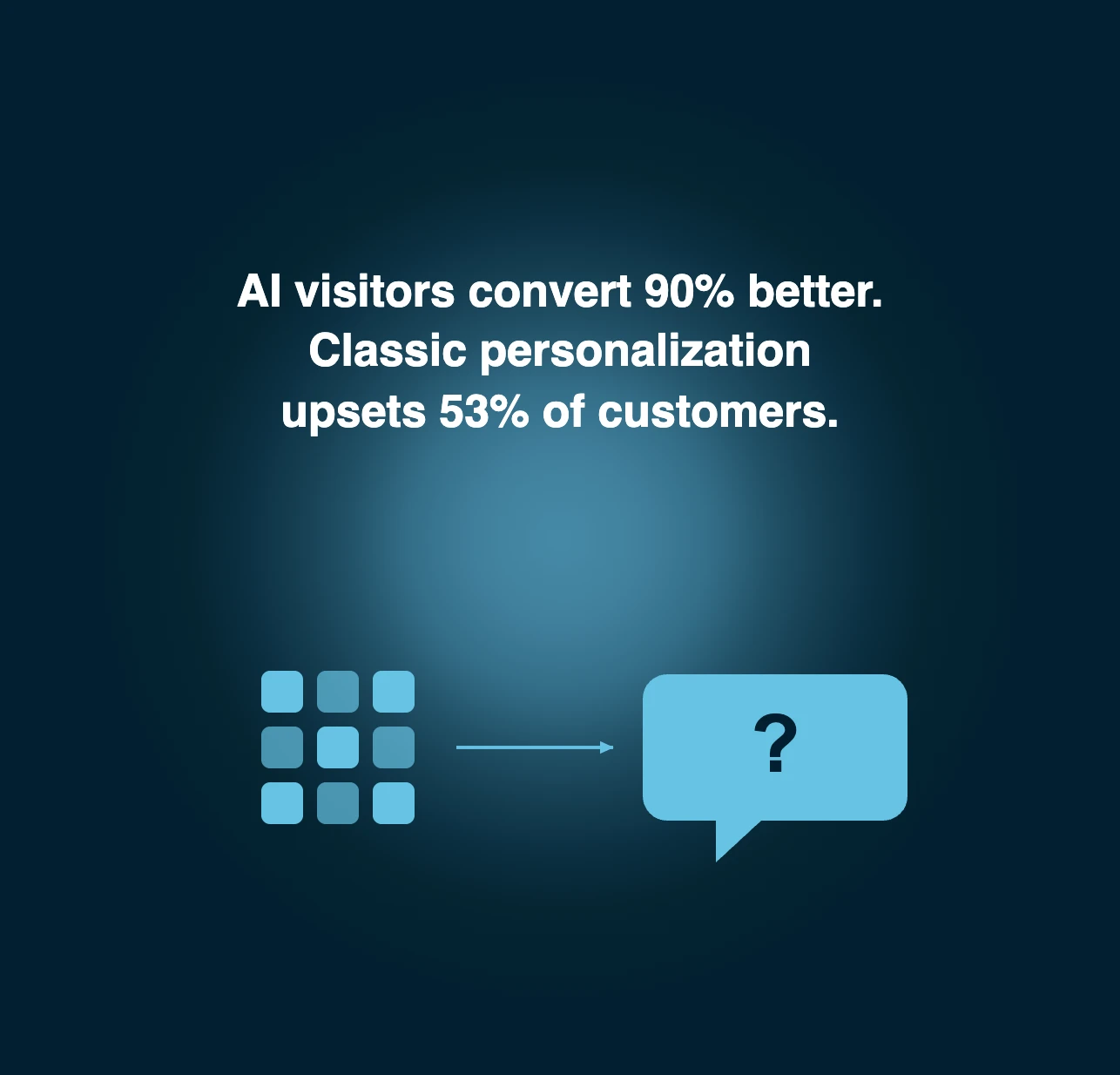
E-commerce personalization trends changed shape in 2026. Online shoppers who arrived from an AI assistant converted 90% higher than other traffic in September (Adobe). Yet Gartner found that personalization creates a negative customer experience for 53% of customers. This guide ranks eight ecommerce personalization trends by the customer data each needs. Your team can create a personalization strategy and build a personalized shopping experience from personalized content, product recommendations and dynamic pricing. Choose what to fund on your brand platform.
Why ecommerce personalization trends are shifting in 2026
AI-referred shoppers now convert better while classic personalization disappoints
Adobe tracks more than a trillion visits to US retail sites. In September 2026 the personalized path that starts in an AI assistant converted 90% better than other online traffic, the widest gap Adobe has recorded. Customer behavior now starts in an assistant. Browsing history, the cart and purchase signals must personalize every product experience in real time. The platform must protect privacy and personal data and suit the technology and the time of each buyer. Your team can learn from each search. An offer based on product content should follow the purchase intent of the shopper.
The classic playbook looks weaker next to that result. Gartner surveyed 1,464 buyers and consumers in late 2024 and published the findings in June 2025.
Did you know?
Gartner found that personalization creates a negative experience for 53% of customers. Those customers are 3.2x more likely to regret a purchase.
The two numbers measure different things. Adobe counts conversion on one channel. Gartner measures how a buyer feels about the tactics. Read together they say that the channel is rising while the tactics that feed it stay fragile. For the mechanics behind AI-driven experiences, read our guide to AI for customer experience. Here we focus on which trend deserves a budget.
What personalization is worth: the numbers that still hold
McKinsey’s 2021 survey remains the most cited benchmark. It found that 71% of consumers expect personalized interactions and 76% feel frustrated when they do not get them. The same article reports that personalization most often lifts revenue by 10 to 15%. The range reaches 5 to 25% depending on the sector and the execution.
Three points hold up in 2026:
- Consumer expectations come from the best online experience, not from your category.
- The revenue range is wide because execution drives the result.
- The data dates from 2021, so treat it as a floor and test the conversion rate on your own site.
From segments to agents: how personalization changed from 2021 to 2026
Personalization moved through four stages: rules and segment targeting, behavioral targeting, predictive models and now agentic commerce. External events pushed each shift. The timeline below dates them from McKinsey’s 2021 survey to the AI Act transparency duty of August 2026.
Read it as a sequence of decisions. Each stage added signals and removed an assumption about the shopper.
Eight ecommerce personalization trends to watch
Trend 1: agentic commerce moves personalization into the assistant
During the 2025 holiday season, traffic from generative AI tools to US retail sites grew 693.4% year over year (Adobe, January 2026). The shopper now briefs an assistant before visiting a brand. Agentic commerce shifts personalization from your site to the autonomous agent that compares options on the shopper’s behalf. These autonomous agents rank businesses by how clearly each one answers. An autonomous agent cannot guess a missing attribute. A developer on your team should explore how the catalog looks to such an agent.
Your catalog must be readable by that agent, with accurate attributes, prices and availability. Two consequences follow. Your brand message must survive being summarized by a third party. And your offers need machine-readable terms so that an agent can quote them without a call.
Trend 2: AI-powered search that reads intent
AI-powered search replaces keyword matching with intent. A shopper types a full sentence about a need and the search returns product items that match the constraints. Personalized search then ranks the results with the shopper’s preference and context. This is the intelligent search personalization that retailers now expect from a vendor solution.
The shift for 2026 is the query itself. Shoppers describe a project and expect a shortlist. Ask three questions when you evaluate it. Does it handle constraints such as budget and dates? Does it explain why a result ranks first? Does it hand over to a human advisor? Search that fails these tests loses the visitor at the first query. Personalizing the first screen of results with a highly relevant shortlist is where most of the value sits. Explore it before any other search change. Our guide to AI-powered search covers how to evaluate it.
Trend 3: visual search and image-led discovery
Some online shoppers start with a photo or a screenshot instead of words. Visual search matches the image to products in a catalog and suggests close alternatives. It fits a category where taste is hard to describe, such as fashion, furniture and vehicles. The user experience on mobile matters because most photos come from a phone.
The prerequisite is clean product intelligence. Each image needs consistent attributes behind it, otherwise the match looks random. Test it on one category first. Measure how often the top match ends in a click and a basket, then compare it with text search on the same catalog.
Trend 4: zero-party data collected in conversation
Zero-party data is information a customer volunteers on purpose: a budget, a trip date, a preference. It answers the loss of trust around tracking. Inference guesses what a shopper wants while a declared preference states it.
Conversation is the richest collection point. Each question a guide asks produces a stated preference that your team can store and reuse with consent. Stated data also lowers risk. A declared budget needs no tracking pixel and no inference model. Store each answer with its date and purpose so that you can honor a deletion request.
Trend 5: one-to-one content generated per visitor
Generative AI now creates product descriptions, offers and landing pages for a single visitor. These AI personalization tactics sit on top of customer data and need review. The upside is relevant dynamic content at scale. The risk is drift from your brand voice and from approved facts.
Expert tip.
Generate content only from approved product and policy data. Review a sample each week so that the brand stays consistent across every personalized page.
Start on low-risk surfaces such as category introductions and email subject lines. Location and device can shape the content too, so that a visitor in Lyon sees local stock. Keep price, availability and legal terms out of generated text and pull them from your systems of record.
Trend 6: predictive recommendations
Predictive recommendations powered by machine learning and artificial intelligence estimate the next product a shopper will want from real-time signals and not only past purchases. Browsing behavior, browsing depth and the browsing path in the current session now weigh more than the purchase history of the account. Each product recommendation becomes a dynamic prediction that the model revises after every click.
Recommendation engines have improved but a recommendation still needs a reason. Show the reason of each recommendation and let the visitor correct it. A corrected preference teaches the model faster than ten clicks. This trend works best with rich data on repeat customers. Our guide to AI product recommendation details the approaches. In practice the pairing of AI and ML in ecommerce lifts personalized product recommendations and dynamic product recommendations on a product page. Without a purchase history or a browsing record, a recommendation stays generic. A shared history of past orders helps. A short history is enough for a first test and a long history refines it. Compare the lift of a prediction against a plain best-sellers list. If the gap is small the model is not yet worth its cost.
Trend 7: loyalty personalization
Loyalty personalization applies the same logic after the sale. A loyal buyer expects to be recognized. Rewards, reminders and service offers adapt to each customer lifecycle instead of following one program for everyone. The goal is customer retention and customer loyalty, with customer satisfaction as the check. Loyalty programs that react to behavior beat a fixed points scheme. Marketing automation can send behavioral email marketing triggers after a cart abandonment or a lapsed reorder. Keep each marketing campaign relevant to one individual project and not to a broad segment.
It suits brands with frequent purchases. For a car or a home, loyalty means the next project years later. Track the stated projects of the customer with consent and use them to time a message rather than to multiply offers.
Trend 8: cookieless personalization after Chrome’s U-turn
Many guides still announce the end of third-party cookies. Google changed course. It kept user choice for cookies in Chrome in 2025. On 17 October 2025 it retired ten Privacy Sandbox technologies citing low adoption, including Topics and Protected Audience.
The lesson is practical. Do not wait for a browser fix. Build personalization on first-party and zero-party data that you collect with consent. Measure the share of your traffic that you can recognize with consent. That share, not a browser roadmap, sets the ceiling of your personalization.
Which personalization trend to fund first
Passive vs active personalization: where each trend backfires
Gartner separates two modes. Passive personalization pushes the next offer. Active personalization helps the buyer clarify what they want and decide. The table maps the measured effects to the tactics most exposed.
Passive tactics carry a cost. Customers exposed to a negative experience are 3.2 times more likely to regret a purchase and 44% less likely to buy again. They are also twice as likely to feel overwhelmed and 2.8 times as likely to feel rushed. Active personalization makes a confident completed decision 2.3 times more likely. The last column is our reading and not a Gartner finding.
Trend selector: prioritize, pilot or deprioritize
Your best trend depends on your purchase type. A coffee reorder and a home purchase do not need the same personalization. Answer three questions about your journeys and the selector ranks the eight topics for you. The questions cover the level of consideration of your purchase and how rich your customer record is. They also cover the share of journeys that start without a clear intent. Each one then shows a prerequisite for your data.
Use the result to open a roadmap discussion. It reflects your inputs, not a benchmark of vendors.
Why past-behavior personalization fails on high-consideration purchases
Businesses that sell high-consideration items face a harder case. Travel, real estate and automotive buyers rarely have a usable record. They buy once every few years and often start without a clear idea. Adobe’s July 2026 data shows the pattern in travel: non-AI traffic still converts better and the gap with AI visitors is only 1%.
Expert tip.
Count how many of your shoppers start a journey without a precise request. If the share is high, favor active personalization over past behavior.
For these journeys the best personalization is a good question. Ask what a buyer needs to know to decide and design the questions around it. Our work on product discovery shows how guided steps replace missing data.
Tactics to leave out for now: personalized pricing and retail media
Personalized pricing appears in many lists. We would not fund it first. GDPR Article 22 protects people from decisions based solely on automated processing, including profiling, when they have legal or similarly significant effects. A pricing model that opaque draws scrutiny and erodes trust.
Dynamic pricing raises the same question. Pricing is a sensitive lever. Dynamic pricing changes the price per visitor. Pricing tests need a legal check. Retail media is an advertising business more than a shopper experience. Kleio does not offer either tactic. Dynamic content and dynamic offers raise the same legal question. Adding them early would spread your budget over tactics that add legal exposure before they add conversion.
A data-first roadmap to implement personalization
Stage 0: unify first-party data before choosing a trend
Ecommerce teams hold data in dozens of systems. Marketing teams hold more in digital tools. Start with this sequence:
- List the systems that hold customer, product and pricing data.
- Unify them into one record per customer and per product.
- Define which consented signals each trend may use.
First-party data gives every later stage a reliable base. Without it a predictive model or an agent answers from partial information.
Stages 1 to 3: pilot, measure, scale
Run one pilot per topic on a single journey. Measure conversion rate, average order value and the share of completed decisions. Add loyalty metrics such as repeat purchase after 90 days. Set the baseline before the pilot starts and keep a control group that sees the standard experience. Without it you cannot tell a lift from a seasonal effect.
Good practice is to optimize one metric at a time. Each metric needs a success threshold before launch. Learn from the patterns in each session and deliver the next test from what you learn. Explore a second touchpoint only after the first one has proven its value.
Scale only the pilots that beat their baseline. Running five pilots at once hides which one worked, so sequence them.
Choosing a personalization solution: six criteria
A personalization solution should deliver measurable performance for your business and your marketing teams and not only a feature list. Compare each vendor solution on six criteria. Each solution should create value for the shopper first:
- Data: it ingests your customer, product and content data without a long integration project.
- Layer: it separates data, decision and channel layers so that a partner or a developer can extend it.
- Insight: it explains why a customer saw a given result.
- Channel: it covers every touchpoint, from web to advisor, for the integration of omnichannel strategies.
- Governance: it gives marketers and developers per-user control.
- Resource: it fits the resources your team has.
Ask each partner for a reference in your industries. A solution that works for fashion retailers may fail on a long purchase. Online retailers and businesses of all sizes ask the same question about each solution: can it explain itself? Treat this step as personalization tactics that scale and not as a one-time purchase of a tool. The choice of an ecommerce personalization platform should follow your chosen trend and never lead it.
Compliance checkpoints for 2026: AI Act, GDPR and CCPA
Three checkpoints apply. Article 50(1) of the AI Act (Regulation (EU) 2024/1689) requires you to tell users when they interact with an AI system, from 2 August 2026. GDPR Article 22 limits solely automated decisions with significant effects. CCPA gives California residents rights over their data.
Review each one against these rules before launch. Businesses should document consent, purpose and the data each personalization uses. Name an owner for each checkpoint in your team so that nothing waits for the legal review at the last minute.
How Kleio approaches these trends
Guided discovery for buyers without a browsing history
Kleio is an agentic commerce platform for complex, high-value sales. Its solution creates a personalized recommendation from what the buyer says. It is not a web or email personalization engine. Its guided discovery asks questions to understand a project and recommends products from attributes, price and availability. Each answer revises the next suggestion.
This fits travel, real estate and automotive retail, where past data is thin. It also feeds the product discovery work described above. Advisors benefit too, since the same conversation gives them the context of the project before they call the buyer.
A memory store that turns answers into zero-party data
Kleio distributes your catalog across three purpose-built stores: product, document and memory store. The memory store keeps what a shopper declares during a conversation. That turns answers into zero-party data that later conversations reuse.
Sensitive fields are pseudonymized before any call to an external model. Per-operation access control limits what each agent can read. Versioned configurations let your team review any change to an agent.
A catalog exposed to AI agents through MCP and UCP
Kleio exposes your product catalog to AI search engines through MCP and UCP. An assistant can then query accurate prices and availability from your own data. Your developers connect the catalog once and keep it current across digital channels. This answers the agentic commerce trend directly. Your brand stays in control of the facts that agents repeat about your products.
The platform is SOC 2 compliant and tenant-isolated. It is also CCPA compliant, which matters for the checkpoints above.
Orpi: personalization at network scale in three months
Orpi, a French real estate network, runs the platform on orpi.com and across its 1,250 agencies. It serves 8,000 advisors. Its CEO Guillaume Martinaud said the platform went live in three months. The project illustrates personalization on a high-consideration purchase, where clients rarely have a usable record. Read the Orpi case study for the full account.