

By 2028 AI agents will outnumber human sellers ten to one. Yet fewer than 40% of sales teams will get a real productivity gain out of those agents (Gartner, November 2025). Agentic commerce is already redefining online commerce and complex, high-value sales: a new form of buying where every agent becomes an actor in the customer journey. This page explains what agentic commerce is, the protocols that structure this shift in electronic commerce and how your company can turn that wave of agents into a measurable commercial result.
What is agentic commerce and why is it taking hold now?
A precise definition of agentic commerce
The term agentic commerce (agent-driven commerce) refers to a new economic model of commerce in which an artificial intelligence agent searches, compares and can go as far as executing a purchase on behalf of a user or a company. It is no longer a simple customer service answering a question asked once: the agent perceives a need, acts on several systems and takes intermediate decisions without human approval at every step. The platform that hosts this agent then becomes an actor in the buying journey just like the customer or the brand. This new form of buying applies as much to a consumer product as to a complex business-to-business sale, which explains why the term covers very different realities depending on the sector observed.
How does an AI agent work inside a buying journey?
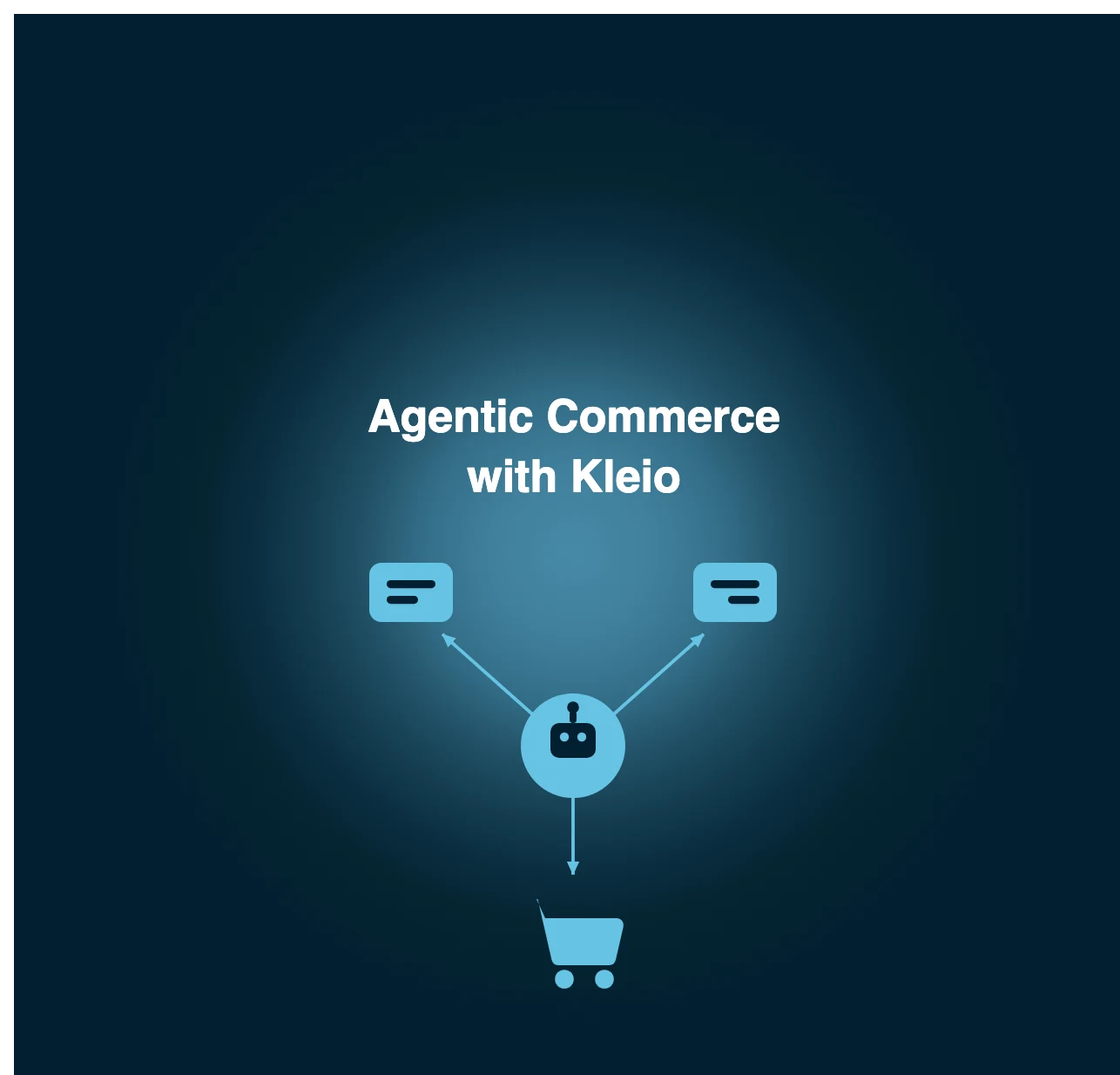
An agentic commerce agent generally follows three stages:
- discovery, where the agent queries a catalog or a knowledge base to map the available offer
- decision, where it compares the options against criteria set in advance (price, lead time, compatibility)
- transaction, where it triggers the final action through a standardized API or a workflow
This triptych forms the backbone of the agentic buying journey itself. This three-stage pattern rests on an agent able to understand a request in natural language rather than a formatted command. It runs in a few seconds for a simple product and over several days for a decision that commits a large budget. In that second case the agent does not close on its own: it prepares the ground, narrows the options and passes a qualified file to a customer or to an advisor at the point where the human brings the greatest value.
Assisted buying or delegated buying: what is the difference?
Two regimes coexist today. In assisted buying the agent prepares the ground but a human user validates the final decision itself. In delegated buying the agent executes on its own within the limits of a mandate defined in advance (maximum budget, quality criteria, lead time). Companies that sell high-consideration products overwhelmingly favour the first regime: the value of the basket justifies a human keeping a hand on the decisive action that closes the deal.
Why agentic commerce is not a chatbot
A chatbot answers a question that was asked. An agentic agent acts: it can query an inventory management system, rewrite a recommendation and trigger a step of the buying journey without waiting for a new prompt. That capacity for action on its own changes the nature of the experience offered to the customer, just as good advice delivered at the right moment changes the outcome of a sale. The distinction is worth stating clearly before going further:
What are the stakes and the risks of agentic commerce?
Three risks now structure the debate. The first is algorithmic bias itself: an agent able to act on its own can reproduce the bias present in the display order or in the data feeding it. The second touches liability: delegating an act of purchase to software redistributes responsibilities between the user, the supplier and the platform. The third falls under regulatory policy and security: in Europe the AI Act classes some uses of agentic commerce among the high-risk systems, which impose reinforced transparency, reinforced traceability and reinforced human oversight, in the same way as the privacy policy applied to every piece of information collected about the customer. These stakes partly explain why adoption stays cautious against the real need of the market. According to Gartner, only 1% of enterprise software applications embedded agentic artificial intelligence in 2024, a figure that should reach 33% by 2028. The legal team is usually involved early in these projects, because an autonomous agent that interacts directly with a consumer commits the liability of the company from the very first interaction, well before any signature.
What are the concrete benefits of agentic commerce?
The benefits identified by market research converge on three axes:
- a reduction in friction inside the buying funnel, with the agent removing redundant steps
- finer personalization, with every recommendation adjusting to the customer's real history
- a fall in cart abandonment, with the agent restarting an interrupted decision at the right moment
According to a 2026 study by the IBM Institute for Business Value, 45% of consumers already use AI for part of their buying journey, a signal that the user experience buyers expect has changed.
The protocols that make agentic commerce possible
ACP, UCP, MCP, AP2, x402: five standards, one objective
Five protocols now structure the IT infrastructure of agentic commerce, each with a precise role in the agent-catalog-payment chain. Together they form an open standard that most of the big online commerce players ended up adopting rather than developing their own closed payment solution. Here is how those five building blocks share the value chain:
The Agentic Commerce Protocol (ACP) co-defined by OpenAI and Stripe is the reference agentic commerce protocol for framing a payment triggered by an agent. The Universal Commerce Protocol (UCP) backed by Google standardizes how a product catalog is exposed to any third-party agent. The Model Context Protocol (MCP) lets an agent query the knowledge base of an enterprise securely. AP2 frames the delegation of a purchase mandate with explicit guardrails. x402 handles micro-payments triggered directly by an agent with no intermediate human involvement (source: French Wikipedia, "Infrastructure technologique" section, accessed September 2026). Together these protocols shift the transaction from human logic toward machine-to-machine exchanges that only solid governance technology can secure. Kleio natively implements MCP and UCP to expose its clients' catalog to third-party agents, including for companies operating in France and in the rest of Europe.
How do these protocols fit together in a transaction?
In a typical transaction the agent discovers the offer through MCP then compares the options of a product catalog structured according to UCP then triggers the payment through ACP or x402 depending on the amount committed. That arrangement keeps a single player from locking the whole chain and lets each company choose its own payment operator.
That modularity also protects the end customer too: if a protocol changes or a supplier is replaced, the other links of the chain keep working with no interruption to the buying journey under way.
Build in-house or choose a platform: what is the real time gap?
Before choosing between the two options, one figure is worth having:
Kleio delivers a platform for agentic commerce from project kickoff to production in 8 to 12 weeks, against several months for an equivalent project built in-house on a generalist cloud stack. The gap owes less to the power of the model than to the integration and data structuring work done upstream inside a ready-made business ontology. That level of managed service spares the legal team and the technical team much of the arbitration an in-house project usually imposes.
From the ecommerce basket to the complex sale: the use cases of agentic commerce
Retail and ecommerce: the ground AI agents already occupy
This is the most documented use case today: a shopping assistant or a buying agent handles product recommendation, the basket, the automated checkout and the payment triggered with no manual confirmation, directly from the merchant's website or through a third-party messaging app. This transformation of online commerce rests on a conversational interface rather than a classic browsing interface: online shopping and online payment become end-to-end digital experiences. The impact is already measured on the conversion rate of many merchants, even though the innovation is young and demands real expertise to keep a badly calibrated recommendation from damaging customer trust. According to an E-Commerce Nation analysis published in December 2025, agent-driven shopping could capture up to 20% of global ecommerce by 2030. It is mature ground, concentrated on low-consideration products where the conversion rate and the cart abandonment rate remain the indicators followed first by every supplier.
B2B procurement: automated ordering at scale
The second use case is procurement between companies. According to Gartner, AI agents will intermediate more than 15 trillion dollars of B2B spending by 2028 and 90% of B2B purchases will be handled by AI agents within three years (Gartner, IT Symposium/Xpo 2025, cited by Digital Commerce 360, November 2025). Logistics and stock management then become data the agent reads directly rather than manual steps, with full traceability on every order placed between a professional buyer and its supplier. This agent-driven logistics also shortens the delay between the request and the real availability of the product, a point every corporate logistics function now follows closely on a cloud shared with its partners.
Complex, high-value sales: the angle most definitions ignore
The dominant definitions of agentic commerce describe a basket or a simple product. They leave out an entire use case: complex, high-value sales, where the journey lasts several weeks and involves a human advisor at a key moment. A property, a tailor-made trip or a vehicle is not chosen the way a fast-moving consumer good is. The budget committed is high, the decision is rarely made alone and several exchanges with a human contact remain necessary before signature.
This is exactly the ground where an agent has to augment an advisor rather than replace them. The brand that gets this transition right takes a strategic lead that is hard to close, because it captures the customer's attention from the research phase onward while keeping intact the trust only a competent human can inspire on a decision of that weight. This area remains the least documented of the ten results that dominate search on agentic commerce, even though it concentrates some of the most profitable sales cycles for a company.
How do you prepare your company for agentic commerce?
Where does your company stand on agentic commerce?
Before investing in a platform you need to know where your company stands today. The diagnostic below takes under two minutes and places your organization against five concrete criteria rather than an intuition:
Every answer feeds an action recommendation your commercial strategy can use directly, with no superfluous technical jargon. A team selling a simple everyday shopping product does not have the same priorities as a legal team in charge of contractual transparency on a cloud shared with its partners, nor the same expectations as an end consumer used to a fast journey.
Structuring your product data: technical prerequisite number 1
An agent can only recommend correctly what it understands. An incomplete or badly structured product record produces a wrong recommendation even with the best model on the market. The management of product data therefore conditions the quality of every agentic interaction before artificial intelligence even enters the conversation. A missing attribute, an obsolete price or an unsynchronized availability is enough to break the trust a customer places in an automatically generated recommendation.
This work concerns classic product catalogs as much as the more complex records of a property or a travel package, where every criterion (surface area, neighborhood, availability date) has to be described in a format the agent interprets without ambiguity. Getting that format right from the start avoids having to fix, under pressure, a product record that is already generating approximate recommendations for customers.
Exposing your catalog to AI agents through API, MCP and UCP
Once the data is structured, it still has to be made reachable. That means exposing your catalog through a documented API compatible with the protocols above. Kleio natively exposes its clients' catalog through MCP and UCP, which avoids a separate integration project for every third-party agent that will query the catalog. Without that step an external agent stays blind to the real offer of the company even when its internal product data is perfectly structured.
Rethinking the sales organization around agents and augmented advisors
The statistic set out in the introduction is worth recalling before acting:
An augmented advisor has the same information as the agent assisting them and keeps control of the moments where the human relationship makes the difference. It is that clear split of roles between agent and advisor that turns a vague strategic intention into a measured commercial result. Optimizing that organization means revisiting the objectives of every piece of advice given to the customer rather than simply adding one more digital layer to an already crowded software stack.
Kleio, the agentic commerce platform for complex, high-value sales
The Knowledge Engine: the brick that removes hallucinations
Kleio's Knowledge Engine rests on three purpose-built stores (product, document, memory) separated by a governance layer. That architecture reaches 99% precision on queries with answers in under three seconds and zero hallucination documented. It is the direct answer to the reliability risk raised above: an agent can only recommend reliably if it leans on governed data rather than on a generic model queried blind.
Separating the three stores also makes it possible to trace precisely where every recommendation came from, a point legal and compliance teams examine closely as the AI Act frames the uses classed as high risk. An agent that explains the source of its answer inspires more trust than a generic model content with a plausible result.
Agentic Orchestration: thousands of AI agents working on your sales
The Agentic Orchestration brick deploys, versions and routes thousands of collaborating agents that run complex sales flows end to end. It is that level of orchestration which turns the proliferation of agents mentioned in the introduction into a genuinely steered lever rather than one more fragmentation risk.
Every agent orchestrated stays versioned and traceable, which lets a company evolve a sales flow without breaking the journeys already running in production. It is that fine lifecycle management that separates a mature platform from a pile of one-off automations.
The Triple Business Ontology: pre-built infrastructure for 7 industries
The Triple Business Ontology structures three layers (function, industry, customer) pre-built for 7 industries:
- Travel & Hospitality
- Automotive
- Real Estate
- Wholesale
- Manufacturing
- Insurance
- Energy & Utilities
That modelling work done upstream explains the time gap mentioned above: Kleio delivers an operational platform in 8 to 12 weeks because the business ontology does not have to be rebuilt from scratch inside every company that buys it.
They chose Kleio: Orpi, Havas Voyages, Selectour, Altarea Cogedim
The Orpi case illustrates the gap. The network put its conversational platform live on orpi.com and across its 1,250 agencies in three months, serving 8,000 advisors able to handle a far wider volume of requests than before. Guillaume Martinaud, CEO of Orpi, sums up the stake: “The real estate journey of tomorrow will be increasingly AI-assisted, and we chose to take the lead. It is a tool that leverages the immense richness of our data to better serve our clients and our 8,000 advisors.”
Havas Voyages, Selectour and Altarea Cogedim follow the same logic in travel and in property development: an agentic commerce platform deployed on a complex buying journey rather than on a simple basket.
Do you want to assess what Kleio would change on your own sales cycles, where a customer still hesitates to buy for lack of enough guidance? Get in touch with a Kleio expert through the contact form to frame a first scope even before booking a meeting.