

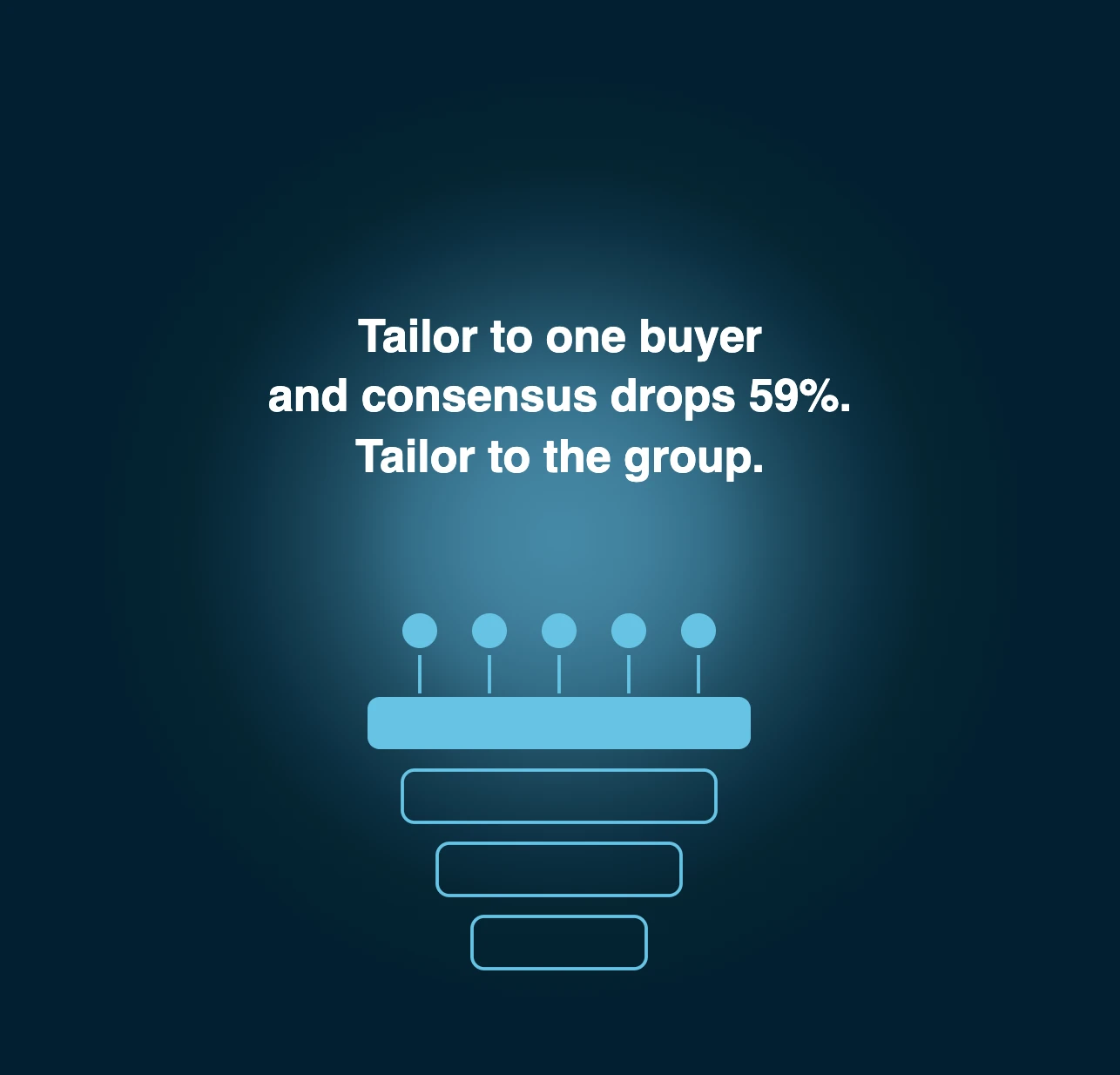
A 2025 Gartner survey of 632 buyers found that tailored content for the individual buyer cuts buying-group consensus by 59%. That finding changes how B2B ecommerce personalization should work. Customer data, specific pricing and product content must serve the account, the contract terms and multiple stakeholders before the individual user. This guide maps four layers of personalization, tests your data readiness and follows the customer journey from a first need to a quote.
What B2B ecommerce personalization is and why it is not B2C personalization with invoices
What B2B ecommerce personalization covers
B2B ecommerce personalization adapts the online buying experience of a professional buyer to the company, the contract and the role behind the order. A personalized product range, custom pricing, relevant content and tailored search results all belong to it. Personalization in B2B relies on purchase history, browsing behavior and company size rather than on consumer taste. Each customer sees rates, payment terms and offers that fit their business. That ecommerce personalization helps companies increase sales and customer retention. A clear personalization strategy lifts conversion rates and customer loyalty through personalized experiences.
Three differences with a consumer store: account, contract, role
A consumer store personalizes for one shopper and one impulse. A B2B ecommerce site personalizes for three layers at once.
- The account. The company has a size, an industry and an order record that shape what it needs.
- The contract. Negotiated rates, payment terms and an authorized range differ from one customer to the next.
- The role. A requester, a technical reviewer and an approver need different views of the same product.
B2C personalization optimizes for the click. B2B personalization has to respect contract terms that a purchasing department negotiated months ago. A customer expecting a negotiated rate who sees a catalog tariff loses trust in the whole ecommerce experience.
A B2B ecommerce channel also carries a different order profile. Orders are larger, recurring and tied to a purchase order or a framework agreement. A business buyer expects the store to behave like an extension of the commercial relationship rather than like a retail shop. Based on these expectations, features such as quote requests, approval workflows and contract pricing become basic requirements. The experience is judged by the speed of a repeat order and not by the novelty of a banner.
Why the buyer is a committee
Gartner counts 5 to 16 people in a typical buying group for a business purchase, spread over up to four functions (Gartner, May 2025). Those multiple stakeholders disagree more than most vendors admit. 74% of buying teams show unhealthy conflict during the decision. Groups that reach consensus are 2.5 times more likely to report a high-quality deal. A personalized experience that serves only the person at the keyboard ignores most of the buying committee. The buying journey is collective even when the cart is not. Every B2B ecommerce customer therefore buys inside a group that has to agree.
Did you know?
74% of buying teams experience unhealthy conflict during a purchase decision (Gartner, survey of 632 buyers, 2025).
What the business case really shows
The upside is real for companies that go all the way. McKinsey’s 2026 Global B2B Pulse Survey covered nearly 4,000 decision makers in 13 countries. It found that market leaders are four times more likely to run true one-to-one personalization: 20% of them against 5% of the others. 60% of those leaders reported double-digit revenue growth in 2025 against 21% of laggards (McKinsey, June 2026).
The survey does not prove causation but the gap is wide enough to matter. Increased conversions and stronger customer loyalty are the benefits that executives expect from this investment. McKinsey also reports that 71% of B2B companies now offer ecommerce. Personalization is therefore a differentiator inside a channel that most competitors already run.
The downside is documented too. A Gartner survey of 1,464 buyers and consumers found a darker side. 53% felt personalization had done more harm than good on their last purchase (Gartner, reported by Digital Commerce 360, June 2025). Those respondents were 3.2 times more likely to regret the purchase. Personalization that helped them change course did better: it made a critical purchase decision 2.3 times more likely to go through. The impact depends on the quality of the personalization efforts, not on their volume.
The four layers of B2B personalization
Layer 1: the contract
The first layer sits in the contract. It holds negotiated rates, volume tiers, payment terms and the range that the customer may order. Its data lives in the ERP software and in signed agreements rather than in the web analytics tool. Done well, custom pricing shows the right net price on every product page and in every search result. Done badly, a catalog tariff displayed next to a contract rate teaches the buyer to distrust the whole store.
Dynamic pricing in B2B means applying agreed conditions at display time. It does not mean moving rates with demand. Each rate shown should come with a short explanation of its source, such as the contract reference. Contract accuracy is critical. Specific pricing for each customer is the first capability to deliver. Based on this data an ecommerce platform can provide each customer with the right unit, pack size and currency.
Key capabilities include contract price lookup, authorized product ranges and payment terms per account. Ecommerce owners should test them with a real customer contract before launch. Payment options per account, such as invoice, purchase order or card, belong to this layer too. A payment method that the finance team of the buyer does not approve blocks the order. Pricing errors are the fastest way to lose trust and clean data is the only protection.
A payment term shown at checkout must match the signed contract. Each delivery term and each payment term should be visible before the buyer confirms. Treat this layer as non-negotiable before anything else is personalized.
Layer 2: the account
The second layer describes the company. Industry, company size, delivery sites and purchase history tell you what a customer reorders and what it has never bought. A mid market manufacturer and a national distributor do not need the same product catalogs or the same landing content. This layer feeds segmentation, reorder lists and recommendations at account level. Its customer data comes from the CRM and from order records.
Among companies that sell online, about a third of revenue now passes through digital channels (McKinsey, 2026). Digital transformation programs in B2B often stop at the catalog. Personalization is the step that makes the channel useful to a committee. The account layer therefore touches real volume and deserves a unified view of each customer. Brands and businesses that sell through distributors can segment the same way.
A B2B ecommerce team can create segments from that data: new accounts, growing accounts and accounts at risk of churn. Each segment receives specific content and offers. A previous purchase of a machine, for example, is a type of signal that justifies a consumables offer. Providing the right offer at the right moment improves the relationship. Customer satisfaction scores from service tickets can feed the same segments.
Layer 3: the buying committee
The third layer is the one that competing guides skip. It asks what every member of the committee must see in the same way: specifications, compliance documents, delivery terms and price logic. Gartner found that content adapted to the buying group improves consensus by 20% while content adapted to the individual lowers it by 59% (Gartner, 2025). Buyers exposed to group-relevant content were three times more likely to report a high-quality deal.
Personalization at this layer means consistency across roles. It does not mean a different message for each person. Marketing teams used to individual targeting have to learn a different logic here.
In practice a buying committee includes a requester, a technical evaluator, a finance approver and sometimes a legal or compliance reviewer. Each one reads the same product page for a different reason. A B2B ecommerce site that offers a shared comparison view, downloadable specifications and a clear delivery promise serves all of them. Personalized experiences at the group level also reduce the back and forth between internal reviewers.
Expert tip.
Before you tailor a page to one role, check what the other roles will see. Shared comparison views and consistent product data protect consensus better than one-to-one messaging.
Layer 4: the individual
The fourth layer covers the person. A role-based view shows the requester a fast reorder screen and the approver a spending summary. Personal lists, saved shopping carts, language and currency preferences and stock alerts belong here along with the browsing behavior collected as first party data. This layer is the easiest to build and the easiest to misuse. Use it to remove friction: faster search, fewer clicks, the right documents at the right time.
Keep every argument and claim aligned with what the rest of the committee sees. A smarter user experience helps the individual without isolating the group. A contact who changes role should see the new view without asking. Time saved on each reorder is the benefit that individuals notice first. Websites that adapt the interaction to the role improve efficiency for everyone who reads them.
How the four layers compare
Each layer relies on a different data source and carries a different risk. The table sets contract terms, account data, committee content and individual preferences side by side with the tariff logic and the purchase data behind them. Gartner supplies the two measured figures. A short definition of each layer follows in the table.
Start at the top of the table and move down. The contract layer protects trust. The individual layer used alone is the one that backfires.
Data, levers and rollout
Which data B2B personalization needs
Every lever depends on a precise source. Six sources cover most use cases:
- Pricing rules and contracts in the ERP drive custom pricing and the authorized range.
- A structured catalog in the PIM (attributes, compatibilities, sales units) drives search and recommendations.
- Order records per customer drive reorder lists and replenishment prompts.
- CRM contacts and notes on the buying committee drive role-based content.
- First party data from browsing shows what an anonymous visitor looks for.
- Technical documents such as datasheets, certificates and safety sheets answer compliance questions.
Customer insight comes from three places (order insight, service insight and field insight): the order record, the service desk and the account managers. Each source adds insight that the web analytics tool misses. Unified customer data is the goal: one profile per company that combines contacts, insights and the type of orders placed. Creating that profile is the first project.
Data from three systems rarely agrees on the first try. Reconcile the data before you display it and keep one owner for each data field. A missing source blocks the matching lever. Most projects stall on the first two sources rather than on the personalization engine. Integration between the ERP, the PIM and the CRM is the essential work. That integration has to run in near real time so that a contract change appears in the store the same day.
Based on the same feeds the portal integration can display order status. Based on shared feeds every channel then tells the same story. API integration costs less to maintain than file transfers. Teams that understand this early save months.
Catalog and pricing by account
Product range and net cost form the largest lever. Each customer sees the products it may order at the custom pricing it negotiated, with volume tiers and payment terms attached. Dynamic pricing here applies contract logic at display time. Examples are a contract price for a named customer, a tier price past a given quantity and a discount with an end date.
Search results, product pages, the checkout and the cart must display the same number. When one screen disagrees with another the buyer calls the account manager and the digital channel loses its purpose. Specific pricing in B2B has to survive every touchpoint. The catalog shown online must also match the catalog that the sales team quotes. A price break at higher volumes is common in B2B and price history by account helps the next negotiation.
Display stock by warehouse so that the buyer sees when the order will arrive. Pricing consistency across the store, the portal and the quote builds trust. Pricing should never surprise the buyer.
Search, reorder and requisition lists
Professional buyers know what they want to reorder. Search should recognize their own part numbers and rank products from their purchase record first. Requisition lists turn a recurring need into one action. A reorder button on a past order saves time that no recommendation widget can match. More steps mean more drop-off. More choice does not help a buyer who already knows the product.
Procurement teams measure the speed of a purchase. Personalization here therefore means fewer steps rather than more suggestions. An online search that ignores the account sends the customer back to email and phone. A discount agreed in the contract should appear in the results as well. The process has to stay fast for a buyer who places the same order every month.
Ecommerce search in B2B is judged by how few clicks lead to a confirmed order. A buyer should never need more than a few clicks to reorder. Display the previous order date next to each product.
Recommendations and cross-sell on repeat purchases
Recommendations earn their place on repeat purchases. Compatible accessories, consumables for a machine already bought and bundles that match a customer’s usual volumes support personalized recommendations and cross selling without distracting the buyer. Keep this lever narrow and logic-driven at first. Our guide to AI product recommendation explains how machine learning models rank products and where fixed logic still performs better.
Product recommendations only work when the product data underneath is clean. Tools that promise a recommendation engine on dirty data produce noise at scale. Distributors and retailers of consumables have the most predictable repeat purchases. For them recommendations are an obvious opportunity.
Portal and self-service personalization
A customer portal gathers orders, invoices, quotes and support requests behind one login. Personalization there means the right content for each role and the right documents for each customer. The demand is documented. 70% of business buyers prefer a fully digital self-service purchase and they consult 7 information sources on average (Gartner, May 2026). A portal that mirrors the customer organization lets the buyer find a past quote or a delivery status without calling the service desk.
Portal features such as saved quotes, shared carts and document libraries reduce interaction costs and give each customer a self-service touchpoint. Many a client also connects its own procurement system to the store so that orders arrive without re-keying. B2B websites that offer these functionality blocks give buyers a reason to return between orders. The portal also supports engagement between orders, with alerts and shared documents that keep the relationship active.
Test your data readiness
Use the checklist below to see which levers your data supports today. Tick every source that your team can use without a new project.
The result lists the use cases you can launch now and the ones that a missing source blocks. Begin with the first gap it names. To see how this plays out in your sector, access the Wholesale datasheet on the Kleio wholesale page.
Privacy: GDPR, consent and professional contacts
Business-to-business does not mean exempt from data protection. Under GDPR (art. 4(1)) the name, the work email and the browsing history of an identified buyer are personal data. The usual legal basis for personalization is legitimate interest (art. 6(1)(f)) with clear information and a right to object (Regulation (EU) 2016/679). In France the CNIL adopted a recommendation on 12 March 2026.
Consent is required to measure email opens for personalization, including in prospecting aimed at professionals. Email campaigns that track opens therefore need a consent mechanism. Explain what you collect and document the purpose of each data field. Build consent and opt-out into the data model before you scale personalization.
The challenges that stall B2B personalization
Four challenges recur.
- Data silos between ERP, PIM and CRM leave no unified customer profile.
- Complex pricing structures are hard to expose in real time.
- Product data is incomplete or inconsistent across catalogs.
- Nobody owns the committee view so each department personalizes in isolation.
McKinsey found that inconsistent information across teams has become the top reason to switch suppliers (McKinsey, 2026). That finding turns a technical issue into a revenue risk. Integration work is unglamorous but it decides whether the personalization strategy ships. No single solution removes these challenges. The challenges that matter most are organizational: who owns the unified customer record and who approves a change.
A tool cannot answer that. Another solution that sits on top of broken data only displays the problem faster. Costs rise when teams discover these challenges after launch rather than before. Data quality decides the outcome. Poor data produces poor personalization and data governance protects the contract layer. A B2B ecommerce project that maps its data sources first avoids most of them.
Where to start and what to measure
Sequence the work by risk. Fix the contract layer first. Add the account layer second and the committee layer third. Open the individual layer last. A pilot can start with a single customer. Start with the segment that reorders most. Map the buying cycle of each segment before you pick a lever. Pilot a personalization strategy on one segment before you extend it to the whole range.
Effective personalization strategies start small and expand once the first results are in. Measure quote conversion rates, average order value, reorder frequency and the share of revenue placed through self-service. Customer retention moves over several quarters so compare cohorts rather than weeks. Compare the buying frequency of personalized accounts with similar accounts that did not receive the new experience. Stop any feature that raises clicks but lowers quote acceptance.
Time to quote is the metric that sales leaders already track. Cutting the time spent on manual quotes frees time for advice. Keep the efforts of the pilot team visible so that results can be compared. The ecommerce team should review these indicators with sales every quarter because account managers see the effect on quotes before the dashboard does. Share the key results with the committee-facing teams so that the personalization strategy stays based on facts.
Personalization efforts should reduce manual work before they boost anything else. Track the efforts saved on each quote. Efficiency gains on quoting and reorder are the first benefits to track. Done well, personalization helps businesses receive cleaner orders and answer quote requests faster.
From a need to a signed quote
Personalizing before the login
Most guides start at the login. The most expensive moment comes earlier. A prospect without an account arrives with a need rather than a part number. It may be a material for a given project, a packaging run in a specific size or a chemical that has to pass a compliance check. Kleio’s industry pages describe the pattern in the same terms: most buyers arrive with a need, not a specification.
Guided discovery turns that need into a specification through questions on use, constraints and quantity. Product discovery can then match the specification to compatible products and to the pricing logic of the customer. A search box and a category tree cannot do that work alone. The buying experience starts well before the first login. Discovery questions should stay short. The buying stage of the visitor changes which question comes next.
A good questioning flow asks what the product is for, which standards apply, in what quantity and by when. Those answers provide the specific attributes that a catalog filter never asks for. They also create the first record of a customer who has no account yet.
When the buyer asks an AI assistant first
Gartner’s March 2026 survey of 646 buyers found that 67% prefer a rep-free experience and 45% used AI during a recent purchase. Part of the research now happens inside an assistant before any visit to your site. A product feed that an assistant can read decides whether your products appear in its answer. That means rates, availability and account conditions exposed through MCP or UCP.
We cover the mechanics in our guide to agentic commerce. For the search side read our guide to AI-powered search. The point here is narrower: personalization has to follow the buyer into a channel you do not control.
The sales rep still closes the deal
The assistant rarely closes. 69% of buyers go back to a sales rep to validate what AI told them (Gartner, May 2026). They have reason to do so. 51% think a GenAI tool is more likely to give misleading information against 49% for a sales rep. The rep who picks up the conversation needs the context already gathered: the need, the constraints, the shortlisted products and the quote in progress. Human support still matters because the rep can explain trade-offs that no interface displays.
Expert tip.
Log what the buyer asked before the handoff. A rep who opens with the buyer’s own words closes the gap between the digital and the human channel.
The journey from need to quote on three surfaces
The path below follows a buyer from a first question to a signed quote across three surfaces. It shows the personalization layer active at each step and the data it consumes. Use it to check where your own customer journey breaks.
The sequence ends where the account manager takes over with the quote already drafted. Our guide to quote generation details that last step.
Where Kleio fits in a B2B personalization stack
What Kleio is and what it is not
Kleio is an intelligence layer rather than a B2B store. It does not run a storefront, process orders or replace your CRM. It connects to the commerce platform, the ERP, the PIM and the CRM that you already own. Kleio serves enterprise and top mid market companies. In personalization terms your platform keeps the transaction and Kleio handles the conversation that leads to it.
The two solutions offer different capabilities and they work together. Many B2B ecommerce platforms and tools offer personalization features inside the store. Kleio adds guidance across the website, the advisors and AI assistants without replacing those solutions. A brand that already runs a store keeps its investment. In a B2B ecommerce setup the store remains the place where orders are placed and invoiced. Kleio provides the guidance that happens before and around that order.
A Knowledge Engine fed by pricing rules, contracts and ERP data
The Knowledge Engine sits at the center. It spreads your range over three purpose-built stores for product, document and memory data with a separate governance layer. For wholesale and manufacturing, Kleio connects it to:
- pricing rules and corporate contracts
- ERP and PIM data
- purchase history and customer preferences
- inventory and availability
The platform is SOC 2 compliant and tenant-isolated. Access control works per operation so that each agent only reads what it is allowed to read.
Guided discovery and personalized quotes
Kleio’s AI agents ask the questions that turn a need into a specification. They then match it to products and prices from the Knowledge Engine. The buyer receives a personalized quote that stays conversational: quantities, options and terms can be refined in real time. Use cases on the industry pages include industrial supplies, construction materials, custom packaging and chemicals with compliance checks. These are use cases rather than named customer stories. Each one relies on the same four layers described above.
A copilot for the sales advisor
On the commercial side Kleio gives the sales advisor one view of the product range, the CRM, pricing rules and customer contracts. The copilot drafts personalized selling arguments and follow-up emails and builds interactive proposals. The advisor takes over a conversation with its history intact. That closes the loop with the Gartner finding above. The buyer who validates an AI answer with a rep meets a rep who already knows the context.
Making the catalog readable by AI assistants
The third surface connects your range to AI assistants through MCP and UCP with account rules applied. A buyer who asks an assistant for a compatible product reaches an answer drawn from approved data rather than from scraped pages. Your platform and your ERP stay the system of record. To see this on your own catalog and your own contracts, ask for a demo.