


According to McKinsey (cited by IBM Think) 35% of what shoppers buy on Amazon comes from product recommendations. A recommendation engine is the machine learning platform behind that number: it analyzes user data and turns it into personalized suggestions. Those suggestions improve conversion and sales for each customer. This article explains how a recommender works and compares collaborative filtering, content-based filtering and hybrid approaches before deep learning and matrix factorization.
What Is a Recommendation Engine?
Definition: a recommendation engine predicts what a user will want next
A recommendation engine is a software system that predicts which item a user is most likely to want next. It can analyze data about user preferences and item content and then recommend the best matches. The same idea appears under the names recommender system and recommendation system. Behind each recommendation sits a machine learning model that learns patterns from past data to deliver personalized suggestions in real time. Marketing teams and product teams rely on that analysis to improve engagement and relevant personalization at scale.
The data behind it: explicit signals vs implicit signals
Every engine feeds on two kinds of data. Explicit data is what users state themselves: ratings, likes, comments and reviews. Implicit data is what they reveal through user behavior: browsing patterns, cart events, clicks, past purchases and search queries (IBM Think).
Implicit feedback such as search history and browsing history dominates every recommender in practice because users rate very few items but click on many. Customer data from social media can add context but raises privacy questions. The catch is noise: a click is not a preference and only careful analysis separates real interest from accidental activities. A good recommender weights signals by strength and refines its picture of user preferences over time. A purchase counts for more than a page view.
Did you know?
According to McKinsey (cited by IBM Think) 35% of what shoppers buy on Amazon comes from product recommendations and 80% of what viewers watch on Netflix comes from algorithmic suggestions.
Where you already meet one: Amazon and Netflix
You meet a recommendation engine every time Amazon shows "customers also bought" or a streaming home screen fills with titles. McKinsey, as cited by IBM Think, puts 35% of Amazon purchases and 80% of Netflix viewing on recommendations. Netflix puts the combined effect of personalization and recommendations at more than USD 1 billion a year in retained revenue (Gomez-Uribe and Hunt, ACM Transactions on Management Information Systems, 2015). For a retailer or a media service the engine is core revenue infrastructure and not a cosmetic widget.
How a Recommendation Engine Works: The Three-Stage Pipeline
Stage 1: candidate generation narrows the catalog
Scoring every item for every user in real time is impossible at scale for any recommender. Candidate generation solves this by cutting the catalog down fast. In Google's machine learning guide the system starts from a huge corpus and generates a much smaller subset. YouTube reduces billions of videos to hundreds or thousands. Cheap methods do the job here: embeddings, vector search and popularity lists. Association rules are one example and a recommender can run several of these techniques in parallel and merge the shortlists.
Stage 2: scoring ranks the candidates with a machine learning model
The second stage applies a heavier model to the shortlist. Scoring can afford each richer feature such as user history, item attributes and context because the subset is small. Machine learning algorithms such as gradient boosting or neural networks fill this role. The model uses each feature to analyze context and estimates the probability that the user clicks or buys each candidate. The recommender then keeps roughly ten items for display. This is where machine learning earns its cost: a precise model on a few hundred items instead of a rough one on millions. Accuracy matters most at this stage and the model keeps improving with new training data.
Stage 3: re-ranking applies business constraints, diversity and freshness
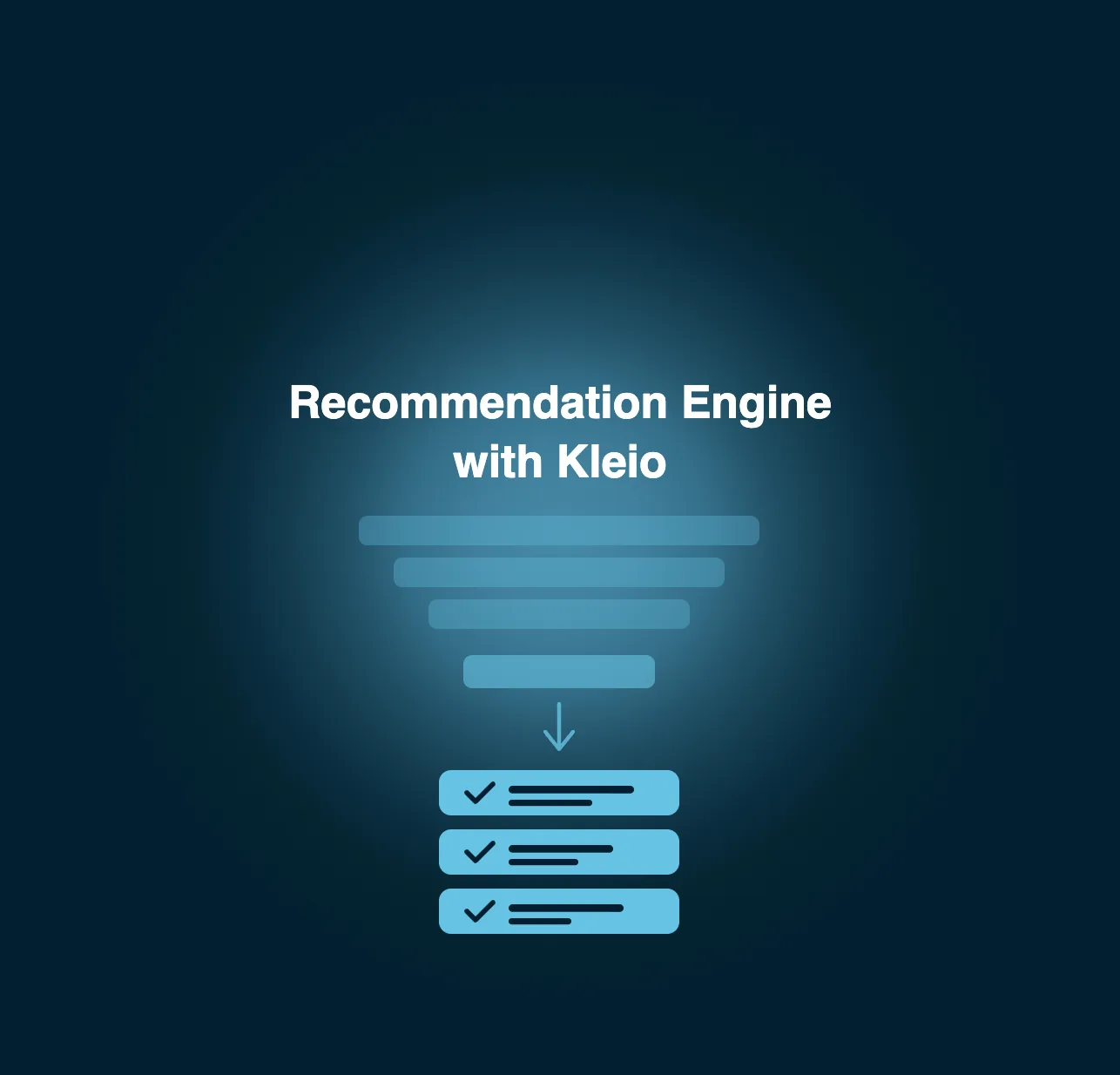
Re-ranking is the last process in the pipeline and adjusts the scored list with constraints that a model alone does not capture. It removes items the user explicitly disliked and boosts fresher content. It also enforces diversity so that ten near-identical products do not fill the page. Business rules enter here too: stock levels, margin and exclusions. The diagram below shows the full funnel. A model can be accurate and still produce a bad page without this final layer. Each preference signal can veto a candidate here. Teams often add this step last and it is the one that decides the user experience.
The funnel above also explains why cheap methods lead and costly models follow.
Recommendation Engine Types and Algorithms
Collaborative filtering: learning from similar users
Collaborative filtering recommends items that similar users liked and uses historical preferences as its main resource. If two users rated ten films alike the engine suggests to one what the other loved. It is a method that needs no knowledge of the content: only the interaction history between users and items. That is its strength and its weakness. With limited data it fails, especially for new users.
Content-based filtering: matching item attributes to user preferences
Content-based filtering compares item characteristics with a user profile. A reader who finishes three blog articles on data science gets more articles with the same topics. It works without other users and handles new items well. The cost is a narrow bubble of preferences: the engine keeps serving more of the same content and rarely surprises.
Hybrid recommendation systems
A hybrid recommendation system is a data-driven technique that combines collaborative and content-based signals. Content features cover the cold start period and collaborative signals take over as interaction data accumulates. Most production recommender systems are hybrid in some form and many combine more than two approaches. The design question is not whether to blend approaches but how to weight them as the data grows. Each service team should document its preference weights and review them with a regular evaluation.
Matrix factorization and the Netflix Prize lesson
Matrix factorization is an accurate technique that compresses the huge user-item matrix into small vectors of latent factors. A user and an item match when their vectors point in the same direction. The method became famous through the Netflix Prize, the open competition Netflix ran from 2006 to 2009 with a USD 1,000,000 prize for any team that improved its Cinematch algorithm by 10%. A team cleared the bar, and Netflix still never put the full winning solution into production. Its own engineering team gave the reason: the extra accuracy measured offline did not justify the engineering effort needed to run those models live (Netflix Technology Blog, "Netflix Recommendations: Beyond the 5 Stars", 2012). The lesson for people building a recommender: the best offline score is not automatically the best production model.
Deep learning and two-tower models
In deep learning neural networks that learn representations replace hand-built features. The two-tower design uses one network for users and one for items and places both in the same embedding space. Retrieval then becomes a fast nearest-neighbor search and improves performance at scale. Because towers accept features and not only IDs they help with new users and items. The same technique powers natural language models that read item descriptions and enhance matching. Natural language processing reads descriptions and metadata such as genre or song tags while sequential models follow the order of user interactions. Current trends in the technology point to reinforcement learning, which goes further by optimizing for long-term engagement instead of the next click.
Which recommendation engine approach fits your catalog?
The right approach depends on your data and not on fashion. Recommendation algorithms and filtering approaches differ mainly in how much historical data and user interactions they need. Four variables decide it and give you useful insights: catalog size, signals per item, purchase frequency and attribute richness. Dense behavior data favors collaborative filtering or deep learning and a driven optimization of the ranking model. Rich product details with little past data favor content-based filtering. Rare purchases with detailed specifications call for reasoning on attributes and constraints. Depending on the answers the best technique changes. Use the diagnostic below to see which approach matches your catalog and which risk to watch first.
The diagnostic summarizes the logic above. Rare and detailed purchases point away from classic models and toward reasoning.
Benefits, Use Cases and Challenges of a Recommendation Engine
Business benefits: revenue, conversion and engagement
Good recommendations increase conversion rates and improve customer experience. McKinsey estimates that personalization can raise revenue by 5% to 15% and lift conversion rates by 10% to 15% (cited by IBM Think). The same source reports that 76% of customers feel frustrated when they do not get personalized interactions. A recommendation engine also helps increase user engagement and customer satisfaction: relevant suggestions keep visitors browsing longer and bring them back.
Expert tip:
Do not judge a recommender by clicks alone and do not trust A/B testing on a single week. Track sales per session and return rate next to click-through so that the recommender cannot win by recommending only cheap and popular items.
Use case: retail and e-commerce
In retail the recommender powers "similar products", "frequently bought together" and cart suggestions. It supports retention and efficiency in advertising spend and it improves average order value by showing complementary items at the right moment. Product recommendations on category pages help shoppers who arrive without a precise idea and improve the overall customer experience on commerce sites. The quality of the product data decides the result: missing fields mean weak content-based matching.
Use case: streaming and content platforms
Streaming services rank movie and video catalogs for each viewer and sort songs or shows by genre. The service attributes most of its viewing to recommendations (80%, McKinsey via IBM Think). The recommender here applies optimization for watch time and user satisfaction over a very large catalog and with abundant implicit data. That abundance is exactly what makes collaborative filtering and deep learning work so well in this setting.
How to measure a recommendation engine
This overview of metrics matters because applications differ. Offline metrics such as RMSE or precision compare predictions with past interaction logs. Online metrics measure what users actually do: click-through, conversion and sales per session. Offline gains often fail to carry over to production, as studies and the Netflix Prize showed. Run controlled experiments before any rollout and treat the offline score as a filter and not as proof.
Offline metrics such as RMSE and precision filter models cheaply while online A/B testing gives the real answer on conversion and sales.
Cold start and data sparsity
The cold start problem appears when the system has little data to draw from, especially for new users (IBM Think). Sparsity is its cousin: most users leave a tiny interaction history across the catalog so the matrix is nearly empty. Common remedies are content features, popularity fallbacks and a few onboarding questions. Each technique reduces the problem without removing it.
Bias, privacy and explainability
Every recommender amplifies what is already popular and can lock users in a filter bubble. Financial services and other regulated sectors feel this most because each preference signal can carry risk. They also depend on personal data: privacy rules limit what you collect and how long you keep it. Finally an opaque model is hard to explain to a customer or a regulator, so write down which signals drive a recommendation before anyone has to ask. Monitor diversity and set a clear policy on data sharing before the recommender goes live.
Where Classic Recommendation Engines Break: High-Consideration Catalogs and Kleio
Why interaction history runs out on rare, high-value purchases
Classic engines assume repeated behavior. A person buys a book every month but a home, a cruise or a car once in several years. Data per item stays tiny and the user-item matrix is almost empty. Worse, around 60% of buyers do not know what they want when they start (Kleio). A model trained on past clicks has little to learn from and the matrix stays sparse. The table below sums up the gap.
Classic engines rely on past behavior and suffer from cold start. Reasoning on attributes and context fits rare high-consideration purchases such as travel, real estate and automotive. Our blog covers the shopper side: read more on agentic discovery for the shopper-side view.
From behavioral prediction to reasoning on attributes, constraints and context
For high-consideration purchases the recommender must reason and not only predict. It reads product attributes, price, availability and the relations between products. It asks the buyer questions and updates its answer from each reaction to surface new insights about the buyer's preferences. A rejection is not noise: it makes the recommender revise the next recommendation. This turns the recommendation engine from a ranking model into a guided conversation that qualifies the need as it goes.
How Kleio's Knowledge Engine powers product recommendations
Kleio is an Agentic Commerce platform for complex, high-value sales. Its Knowledge Engine unifies product data, documents and conversation memory in three purpose-built stores. This is the data problem solved first: agents answer from approved data with 99% precision, sub-3-second responses and no hallucination. A Triple Business Ontology covers seven industries, from travel to real estate and automotive. Projects go from kickoff to production in 8 to 12 weeks. Learn how the Knowledge Engine works.
What it looks like in production: the Orpi network
Orpi runs Kleio across 1,250 agencies and 8,000 advisors and the preference of each buyer shapes the shortlist. The platform went live in three months. Buyers describe a vague project and the recommendation engine surfaces matching properties and hands qualified leads to advisors with the context already captured. See the Orpi case study for the full results.