

Most buyers in high-consideration categories do not arrive knowing what they want. They arrive with a pull: a sense that they need to move house, renew a fleet, book something memorable or restock ahead of a season nobody can forecast precisely. Agentic discovery is the use of autonomous AI agents to build the preference those buyers do not yet have, by putting real products in front of them and learning from every reaction. It is not a faster search box, and that distinction decides whether your catalog converts the undecided majority or only serves the decided tail. This guide covers what agentic discovery is, why conversational search underperforms at the discovery stage, how the loop actually works, and what your product data needs to support it.
What Is Agentic Discovery? Definition, Scope and What It Is Not
Agentic Discovery Defined in One Sentence
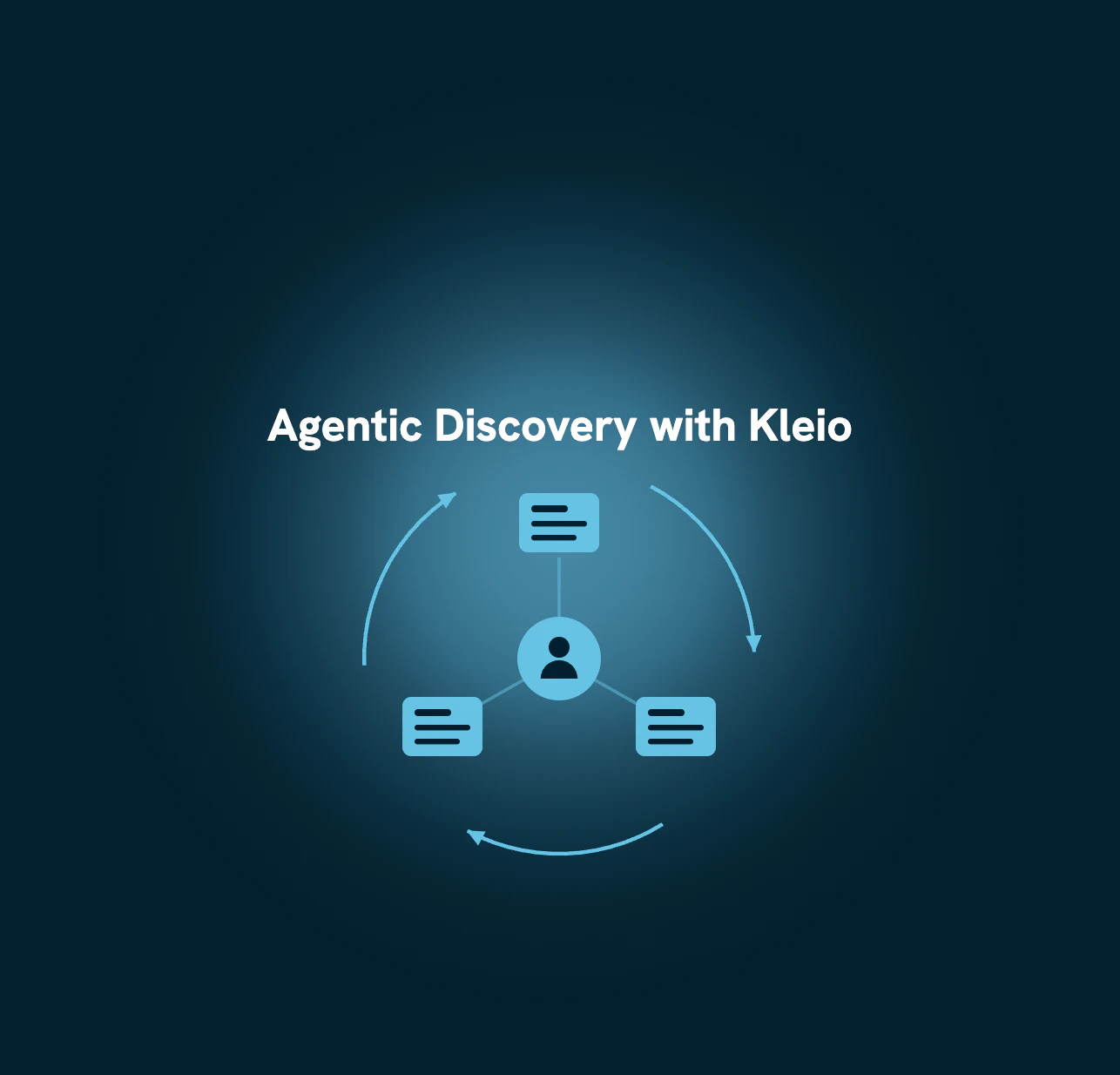
Agentic discovery is the process by which autonomous AI agents help a buyer construct a preference by exploring and reacting to real products, in contrast to agentic search, which executes a preference the buyer already holds. The difference sits in the objective rather than the interface. A search system assumes the answer exists and only has to be found, so its job is retrieval and ranking. A discovery system assumes the answer has to be built, so its job is to expose tradeoffs, present concrete options the buyer can react to, and refine its model of that buyer after every reaction, including the rejections. Both can run through a conversation, both can call the same catalog, and they still produce different outcomes, because one of them serves an intent that already exists and the other one creates it. For a revenue team, that is not a semantic argument. It decides which half of your traffic you are actually equipped to convert.
Agentic Discovery vs Agentic Search, the Distinction That Matters
The dominant thesis in AI commerce right now is compact: expose your catalog through MCP or a set of tools, let the buyer describe what they want in natural language, and let an agent do the rest. For genuine strong intent, that thesis is correct. "Rebook the same route", "reorder the same set of parts", "find me the 8:40 to Lyon" are retrieval problems, and an agent with an API beats every other interface at them. The thesis breaks on the assumption buried inside it, that the buyer shows up with a formed preference that only needs executing. In travel, real estate, automotive retail, hospitality, wholesale and big-ticket equipment, that assumption rarely holds, and no amount of reasoning quality rescues an agent that has been asked to retrieve an answer the buyer has not yet formed.
Three Other Meanings You Will Meet in Search Results
The term is overloaded, and a search for agentic discovery returns three unrelated things alongside the one that matters to your revenue. In software engineering, agentic resource discovery describes the open specification work that lets one agent locate and verify tools, skills or other agents across a distributed cloud. In research, Microsoft Discovery and comparable academic work use coordinated agents to generate hypotheses and run simulations in materials science or drug discovery. In security, vendors use agentic discovery to describe the inventory of every non-human identity in an environment, so that no autonomous agent runs unowned or over-privileged. All three are real, none of them is about a buyer choosing your product, and mixing them up is why so many pages ranking on this keyword are written for developers or security teams rather than for the people responsible for conversion.
Why Most Buyers Cannot Be Searched Into a Decision
The Weak-Intent Majority
Roughly 60% of buyers in the categories we serve do not initially know what they want, and the data underneath that figure is not subtle. In automotive, about 60 percent of shoppers begin the process without a specific make or model in mind, which is why the industry named the early stage the discovery phase. In real estate, the trigger is emotional long before it is a specification: a first-time buyer feels a pull toward stability or belonging months before they can state a budget, a district or a room count, and those hard parameters emerge during the search rather than before it. In travel, even the dominant platform in the category has conceded the point publicly, acknowledging that what it was always good at was the last mile from search to booking, and that the genuinely hard problem was meeting customers earlier, while they were still working out what they wanted. Research on the consumer decision journey adds a detail that breaks most funnel models: the consideration set often expands during active evaluation instead of narrowing toward a pre-selected answer.
The Filter Paradox
Here is the structural trap that catches conversational search in these categories. When intent is strong, natural language is a worse interface than a filter, because describing a preference in a sentence and waiting for an agent to parse it is slower than three clicks on price, dates and location. When intent is weak, a better parser does not help either, because it cannot return an answer the buyer has not yet formed. A more fluent way to ask "what do I actually want?" retrieves nothing useful. So a pure conversational search layer lands in an uncomfortable middle: too slow for the decided, too shallow for the undecided. This holds independently of model quality, which is why the semantic search promise in high-consideration categories has disappointed for years while the underlying models kept improving.
Intent Translation Is Not Intent Creation
Look closely at what most semantic features actually do. The dominant pattern, including at the largest platforms, is to take a sentence and map it onto filters that already existed. Type "a family villa with a pool near the beach" and the system applies the matching filters automatically. That is genuinely useful, and it is precisely intent translation: it serves a preference the buyer already holds and does nothing to create the preference the buyer lacks. The strongest counter-argument deserves a fair hearing, because it is a real one. Platforms report that users shifted from single-keyword queries toward richer, discovery-style prompts, and that engagement rose as a result. Two things are worth separating there. Engagement is not a confident, completed, high-value decision, and vendor case studies rarely publish the conversion delta against a strong filter baseline. More importantly, surfacing more of an existing catalog in response to a richer query is still retrieval. It widens the funnel without helping anyone construct a preference they did not walk in with.
Preferences Are Constructed, Not Retrieved
The automation thesis inherits an old and mostly wrong model of the buyer: a rational agent carrying stable preferences that only need to be revealed. Decades of consumer research say close to the opposite. Bettman, Luce and Payne established in 1998 that consumers frequently lack well-defined preferences in memory and instead construct them during the decision itself, using strategies that depend on the task and on how the options are presented. Preference is an output of the decision process rather than an input to it. This is also why more choice can make outcomes worse: in the well-known field study by Iyengar and Lepper, shoppers facing a large assortment were markedly less likely to buy than those shown a small one. Later meta-analytic work found the effect moderator-dependent rather than universal, so the careful reading is not that less choice is always better, but that buyers who cannot evaluate a large set defer or abandon. A raw catalog behind a conversational interface is exactly that large set, presented through a browsing experience that is worse than the one it replaced.
If preferences are constructed, the system's real job is to help construct them. That is what critique-based recommenders were designed to do: the buyer starts from a concrete example, reacts to it ("cheaper", "more like this but closer to the center"), and the model refines its estimate across several cycles. The literature is explicit that this approach matters most in high-risk, first-purchase domains where users have no fixed preferences to begin with. Property, cars and travel are the textbook instances, not the edge cases.
How Agentic Discovery Actually Works, Step by Step
Step 1, Seed the Buyer Model With Priors
The loop does not start from zero. A product recommendation engine worth deploying seeds its buyer model from what you already hold: CRM records, segment membership, prior transactions, the channel the buyer arrived through. Those priors are not treated as facts. They are beliefs with a confidence score and an origin tag, so the system can tell the difference between something the buyer said, something they demonstrated by reacting, and something inherited from a segment average. Personalization starts at turn one instead of after ten questions, and the profile stays auditable, which matters the moment a privacy or compliance review asks where a given assumption came from.
Step 2, Present a Small, Diverse, Legible Set of Real Products
Instead of returning a long ranked list, the engine presents a short set chosen to spread across the parameter space of your catalog: different price points, different tradeoffs, different shapes of the same need. The point is not to guess right on the first try. It is to give the buyer something concrete to push against. A buyer who cannot articulate a budget will still tell you, instantly and reliably, that one option feels too expensive and another is priced low enough to make them suspicious. That reaction carries more structured data about their preference than any question you could have asked them.
Step 3, Learn From Every Reaction, Including the Rejections
This is the step that separates discovery from search. A rejection is not a failed result, it is the most informative signal in the session. When the buyer dismisses an option, the engine does not simply remove it, it infers which attribute triggered the rejection, revises its belief about that attribute, and re-queries the catalog against the updated model. Kleio's Agentic Discovery Engine is built around exactly this behavior: the catalog exposes its parameter space, and a "no" re-queries it rather than ending the conversation. Across live deployments that loop runs at 99% accuracy with sub-3-second response times, fast enough that the buyer experiences it as a conversation rather than as a series of page loads.
Step 4, Hold Structured and Free-Form Memory in One Profile
Hard parameters and soft signals belong in the same place. A delivery window, a maximum budget and a compatibility constraint are structured; "somewhere my parents can visit easily", "nothing that looks corporate" and "I got burned last time on lead times" are not, and a filter cannot express either of them. A probabilistic memory store holds both, adds beliefs, revises them when the buyer contradicts themselves, and erases them when they stop applying, each with a confidence score attached. This is also what makes the profile survive a journey that spans weeks and several stakeholders, instead of resetting every session and asking a prospect the same qualifying question for the third time.
Step 5, Convert or Hand Off With the Full Context
The loop ends in an action rather than a report: a checkout, a booking, a quote request, or a handoff to a human advisor carrying everything the engine learned. That handoff quality is often the real product. A sales team that receives a lead with the constructed preference attached, the rejected options, the confirmed constraints, the open tradeoff, converts differently from one that receives a form submission with a name and an email. In an advisor-assisted category, the same engine runs behind the counter as a copilot, so the human and the agent work from one profile instead of two.
Where MCP, UCP and Agent Protocols Actually Fit
None of this is an argument against agents or against protocols. MCP and UCP are real and useful, and Kleio implements both natively so your catalog can be exposed to external AI search engines as a distribution channel. But they are plumbing. A protocol exposes a catalog; it does not know how to help a person come to want something they had not imagined. Without genuine mastery of the conversation and of the catalog beneath it, an agent automates, faster, a search the buyer was never equipped to run. The defensible advantage was never the protocol, which everyone will eventually have. It is the discovery experience built on top of it, and the model of the buyer that experience encodes.
Where Agentic Discovery Creates Revenue, Industry by Industry
Travel and Hospitality
Travelers rarely start with an itinerary. They start with a window of dates, a budget they are unsure about and a feeling about the kind of trip they want. Kleio's clients describe the shift directly: Havas Voyages CEO Christophe Jacquet reports an agentic commerce deployment that has already boosted lead generation through an engaging, personalized conversational experience, and Selectour CMO Bertrand Bonnefoi frames the same move as accelerating the industry toward the agentic commerce era.
Real Estate
Thousands of properties, shifting criteria and a decision loaded with emotion make property the clearest case for preference construction. Orpi CEO Guillaume Martinaud calls the result a disruptive tool that leverages the immense richness of the network's data across 1,250 agencies, a case covered in detail later in this guide. Buyers discover what they actually want by reacting to real listings, and advisors inherit a qualified preference instead of a wish list.
Automotive Retail
About 60 percent of car shoppers begin without a make or model in mind, and the configuration space runs to millions of valid combinations once trims, options and financing terms are included. An engine that reasons over compatibility, availability and the buyer's reactions narrows that space in a few turns and routes a qualified match to the nearest dealer, instead of leaving the buyer to filter a catalog they cannot yet evaluate.
Wholesale and Manufacturing
Business buyers look different on the surface and behave the same way underneath. A restocking decision or a request for quote against technical specifications still involves a large parameter space, a constrained budget and tradeoffs the buyer cannot fully articulate up front. Agentic discovery here means proposing viable configurations, learning from what gets rejected and applying automation to a process that otherwise spans procurement, engineering and sales across several email threads.
Insurance and Energy
Protection and upgrade needs arrive vague almost by definition. A homeowner knows something is wrong with their heating bill, not which system they should install. An engine that presents concrete, priced options and learns from the reactions turns that vague need into a quote-ready lead, which is the same discipline applied to a different catalog.
Is Your Catalog Ready for Agentic Discovery? A Diagnostic
Can Your Catalog Expose Its Parameter Space?
Most catalogs are built to be filtered, not to be reasoned over. They answer "show me everything under 500" and cannot answer "what are the meaningful tradeoffs in this price band". An engine that constructs preference needs to see the shape of the space: which attributes vary, which combinations are valid, where the clusters sit. If your catalog can only return a filtered list, you are equipped for the decided minority and structurally blind to everyone else.
Structured Attributes Instead of Prose Descriptions
Specifications buried inside persuasive paragraphs have to be inferred rather than read, and inference fails quietly. Dimensions, compatibility rules, pricing tiers and availability belong in explicit, machine-readable fields with consistent naming, explicit units and stable identifiers. This is usually the cheapest fix on this list, because the data almost always exists somewhere in the organization, just not in a format an agent can use. It is also the one that silently caps everything downstream, since metadata quality sets the ceiling on what any reasoning layer can do.
Memory That Survives the Whole Journey
A high-value decision rarely closes in one session. It moves across weeks, devices and stakeholders, and it changes shape along the way. An engine without persistent memory treats every interaction as the first one and re-asks questions the buyer already answered, which is precisely the experience that erodes trust in an AI-powered journey. Ask whether your systems can carry a constructed preference, not just a session ID, from a first anonymous visit to an advisor conversation three weeks later.
An Audit Log You Can Actually Show
Every belief added, revised or erased should be recorded, along with what triggered it. That log is not only a compliance artifact. It is how you tune the engine, how you explain a recommendation to a buyer who asks, and how you answer a regulator or a security team without reverse-engineering a model's behavior after the fact. If you cannot reconstruct why the system proposed what it proposed, you do not have a governance story.
A low score on that grid is not a reason to stall a project. It is a punch list, and the next section covers what happens once it is addressed.
From Pilot to Production, Governance, Speed and Proof
The Governance Gap Behind Failed Agentic Projects
Enthusiasm is not the bottleneck; governance is. Gartner projects that 40% of agentic AI projects will be abandoned by the end of 2027, not because the technology fails, but because organizations cannot demonstrate a clear business outcome or control costs as capabilities scale past a pilot. That risk maps directly onto the gaps above: a catalog that cannot expose its parameter space produces recommendations nobody trusts, a memory layer that resets produces a journey nobody finishes, and an engine with no audit trail produces a compliance problem nobody budgeted for. The organizations that avoid this outcome assign clear ownership of data readiness as the first milestone rather than discovering it during a failed pilot review six months in.
What Kleio's Knowledge Engine and Agentic Discovery Engine Change
Kleio's answer to that gap is the Knowledge Engine, three purpose-built stores for product, document and memory data, sitting behind a separate configuration and governance layer that every deployed agent has to pass through. The Agentic Discovery Engine runs on top of it and holds the loop described above: priors from your CRM, structured and free-form beliefs with confidence scores, reaction-based re-querying against your live catalog, and a live audit log of every change. Measured across production deployments, that combination delivers 99% accuracy and sub-3-second response times with a zero-hallucination design that answers only from approved data. Agentic Orchestration then deploys, versions and routes thousands of collaborating agents across the journey, while a Triple Business Ontology covering function, industry and customer means Travel is not treated like Automotive and Real Estate is not treated like Wholesale. The engine runs on your infrastructure, stays provider-agnostic, and works across web, mobile, conversational and advisor copilot surfaces.
Weeks, Not Months, the Orpi Case
Real estate network Orpi is the clearest proof that this moves fast. CEO Guillaume Martinaud committed publicly to a timeline most enterprise software projects would consider unrealistic, and the team delivered: "In three months, we kept our commitment: the platform is live, on Orpi.com and in each of our 1,250 agencies. It is a disruptive tool that leverages the immense richness of our data to better serve our clients and our 8,000 advisors, and positions Orpi where future buyers now make their first searches." That timeline is not an outlier in Kleio's model: enterprise deployments typically go live in 8 to 12 weeks from kickoff to production, against the multi-quarter timelines common with in-house builds, generalist delivery partners or point solutions stitched together after the fact. For a CEO or CRO weighing whether agentic discovery is worth the investment, that speed is often the deciding variable, because a slow deployment erodes the internal sponsorship a project needs to survive its first budget review.
Security and Compliance by Default
None of that speed comes at the expense of security. Kleio's infrastructure is SOC 2 compliant and CCPA compliant, hosted in a tenant-isolated environment, with per-operation, permission-scoped access control, automated access reviews and versioned configurations, so every agent action traces back to an approved policy. Sensitive fields are pseudonymized in flight before any external model call, and monitoring runs 24/7 to block inappropriate requests before they reach a customer. If your catalog, your data and your journey are ready for agentic discovery, the fastest way to find out is to watch an engine work through your own products.