

On 24 March 2026 OpenAI confirmed it was deprioritizing Instant Checkout. On ChatGPT Shopping, the purchase now ends on the merchant site. The shopping assistant remains a new channel for product research, fed by web sources and product data. Here is how this assisted commerce actually works, how to make a product visible in it and where this search engine stops for complex purchases.
How has ChatGPT Shopping worked since launch?
A dated timeline: from April 2025 to October 2026
Five milestones place ChatGPT Shopping where it stands today. On 28 April 2025 OpenAI opened shopping results inside ChatGPT. On 29 September 2025 came Instant Checkout with the Agentic Commerce Protocol, built with Stripe for the United States and Etsy sellers. On 24 November 2025 Shopping Research launched the personalized buying guide. On 24 March 2026 Instant Checkout was set aside. What remains is a discovery space:
For a brand the consequence is direct: product research plays out inside ChatGPT and the transaction closes on its own site.
Where do the recommended products come from?
The user states a need in a natural language prompt and ChatGPT runs a web search. The assistant draws on third-party sources such as Google Shopping, on seller feeds and on the customer reviews published online. Price and availability therefore come from those sources. The tool can get both of them wrong. Retailer inclusion goes through an allowlist (Search Engine Journal, 24 November 2025).
Shopping Research: the guided buying mode
Shopping Research turns a vague request into a buying guide. The assistant asks narrowing questions, then compares products side by side. Since March 2026 it also accepts image search. This feature runs on a specialized GPT-5 mini model and stays open to the Free, Go, Plus and Pro plans (Search Engine Journal, 24 November 2025). The interface and the buying experience of the shopping assistant guide the user without leaving the conversation.
Why was Instant Checkout set aside?
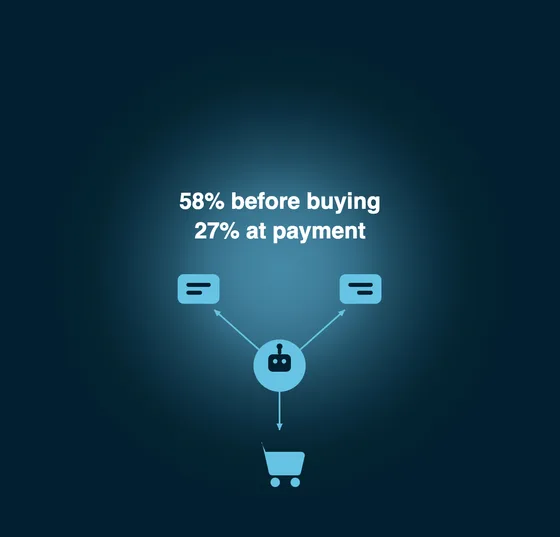
The built-in checkout never launched in France. It was limited to the United States and to Etsy sellers. On 24 March 2026 OpenAI redirected the protocol toward sharing product feeds and promotions. Target, Sephora, Best Buy and Wayfair adopted it. Usage explains the choice. AI steps in before the purchase for 58% of French users but at payment for only 27% (Fevad / Odoxa, 2026). The merchant site keeps the transaction.
What ChatGPT Shopping changes for shoppers and for brands
Usage that grows before the purchase, not at payment
31% of French online shoppers already use generative artificial intelligence for their online purchases. That rises to 49% among 15-24 year olds (Fevad / Odoxa, 11 February 2026). This artificial intelligence weighs above all on purchase intent and on the early buying journey . On the other hand 57% of online shoppers doubt its commercial neutrality. Trust falls at payment time: 47% before the purchase against 30% at payment.
A new discovery channel with a high conversion rate
In the United States, traffic from generative AI to retail sites jumped +693% year over year during the 2025 holidays. Its conversion rate runs 31% above that of other sources. Those visitors leave the page 33% less often (Adobe Analytics). This US figure stays an indicator rather than proof of causality. Bernstein puts agentic commerce at under 1% of US ecommerce (Journal du Net, October 2026).
The reliability limits worth knowing
OpenAI measures 52% product accuracy on multi-constraint queries, against 37% for ChatGPT Search, according to its own internal evaluation. An independent measurement points the same way. Product.ai put 220 buying questions to four engines, on free and paid tiers, five times each. 86% of them produced a repeatable factual conflict on price, specifications or availability (September 2026). The rate climbs to 97% on comparisons and falls back to 75% on a plain specification lookup. A factual conflict is not a systematic error. It is still enough to break trust at the first click. The quality of the answer depends on the quality of the product page data. Checking price and availability at the retailer stays essential.
How do you make your products visible in ChatGPT Shopping?
Product feed and Agentic Commerce Protocol
The product feed is the basis of visibility. The Agentic Commerce Protocol (ACP) is an open standard co-developed by Stripe and OpenAI. It now serves to share product feeds and promotions. Shopify merchants enter it automatically through Shopify Catalog. Data travels through the feed and through the retailer API. More advanced retailers build an app inside ChatGPT, and Walmart is one example. Our article on agentic commerce covers the neighbouring protocols.
Robots.txt and OAI-SearchBot
According to OpenAI documentation, a site that blocks OAI-SearchBot cannot appear in ChatGPT search answers. A change to robots.txt takes around 24 hours to register. GPTBot, which serves model training, is a separate crawler. Allowing search without allowing training therefore stays possible. This technique protects control over the data without closing the channel.
Product page, customer reviews and third-party sources
The assistant reads the same signals as an attentive shopper. Everything starts with the product page. Three generative engine optimization (GEO) signals stand out:
- structured attributes such as material, dimensions or compatibility
- publicly accessible customer reviews
- brand citations in the press or in comparison sites, the fruit of content marketing
These signals feed the product selection before any buying decision.
Price, stock and referral traffic measurement
A price or stock error breaks user trust at the first click. Syncing that data in real time is therefore a strategic priority. Comparing the feed price and the displayed price every day avoids the gaps. You also have to isolate the referral traffic coming from ChatGPT in your analytics, in order to measure this new channel. Without that, there is no way to tie visibility inside the assistant to sales.
Diagnostic: can ChatGPT Shopping read your catalog?
Eight questions are enough to place your catalog. They cover the product feed and ACP, OAI-SearchBot and the syncing of price and stock. They also cover product page attributes, reviews, third-party sources, ChatGPT traffic tracking and MCP access. This tool reads those eight signals and returns a score and three actions:
A low score signals a product base to structure. A ready base stays limited by the nature of ChatGPT Shopping, as the next section shows.
Why ChatGPT Shopping is not enough for high-consideration purchases
A carousel built for retail references
The classic product carousel assumes a displayed price and stock per reference. It suits an average order value of 62 EUR for French ecommerce in 2025 (Fevad / KPMG, via Journal du Net). A trip, a property or a vehicle follow another logic: around 60% of buyers do not know what they want at the start. Our analysis of ecommerce product discovery compares the levers that answer that still-vague need. The customer needs to be guided, qualified and reassured before receiving an offer. Comparing several offers takes time for a trip or a property.
Travel, real estate, automotive: what is missing
For these three sectors the price changes with dates or financing. Availability depends on a unique item. ChatGPT Shopping covers discovery and comparison. It covers neither qualification, nor the quote, nor the booking, nor the handoff to an advisor.
What brands have to expose to AI agents
A brand selling complex offers has to connect the assistant to real-time data, a business ontology and an MCP endpoint or a ChatGPT app. Product information alone is not enough: the agent also has to qualify the need and hand over to the advisor. This agentic commerce solution ties the offer, the price and the advisor into one tool.
Kleio: connecting your catalog to ChatGPT for complex sales
A Knowledge Engine for governed data
The Kleio Knowledge Engine spreads the offer data across three stores dedicated to product, document and memory. A governance layer separates them. This architecture reaches 99% precision on queries, with answers in under three seconds and zero hallucination. Kleio solves the data problem before deploying any agent. An assistant that recommends well has to know its offer reliably, through rigorous data management.
MCP and UCP exposure to ChatGPT and Gemini
Kleio exposes its clients' catalog to AI search engines through MCP and UCP, directly inside ChatGPT or Gemini. The offer stays governed and exposed through a single endpoint. This surface completes the page on direct distribution inside AI assistants. Our analysis of MCP and A2A describes how it works technically. The high-intent recommendation arrives where the buyer starts searching.
Orpi, Havas Voyages, Selectour: journeys already in production
Orpi put its platform live in three months on Orpi.com and across its 1,250 agencies, serving 8,000 advisors. Havas Voyages and Selectour deploy the same approach in travel. Kleio delivers in 8 to 12 weeks from project kickoff to production, thanks to 7 pre-built business ontologies, one per industry. Your complex offer deserves real qualification rather than a plain carousel.