

The Next Frontier: Agentic Commerce
We are entering a new era in commerce where digital interactions are shifting from static clicks to intelligent, autonomous exchanges. The path forward is clear. Agents will not only respond to humans but also communicate directly with one another. We envision a world where businesses operate through intelligent, autonomous digital counterparts that can understand needs, make decisions, and collaborate seamlessly across the ecosystem. Agent-to-Agent communication will create a new sales channel that is faster, smarter, and deeply personalized.
Imagine your digital assistant knowing your travel history, budget, and preferences, then reaching out to a travel agency’s booking agent, confirming availability, securing the best rate, and returning the final itinerary to you. No apps. No tabs. No waiting. That is the power of agents talking to agents.
For brands, the same shift unlocks an entirely new operating model: your digital sales agent doesn’t just answer questions - it leads the entire buying journey. It qualifies the user by asking the right questions, uncovers the real project behind their visit, orients them toward the right category, and identifies the exact product that matches their constraints, preferences, and goals. From there, it sells the dream by explaining why this choice fits their larger outcome, handles objections in real time, and drives the transaction to completion, end-to-end.
This is not a distant evolution. It is the next stage of agentic commerce.
Why Businesses Need to Act Now
The move toward Agent-to-Agent systems is already visible in the real world. Look at how platforms like ChatGPT are directly integrating with brands such as Expedia, Estée Lauder, Spotify, Walmart and Booking.com including, where agents are beginning to coordinate, fetch data, compare options, and deliver outcomes autonomously. This shift signals the early stages of a new transactional layer in digital commerce.
The stakes are high: by 2030, the US B2C retail market alone could see up to $1 trillion in orchestrated revenue from agentic commerce, with global projections ranging from $3 trillion to $5 trillion, according to McKinsey research. While discoverability and interoperability remain challenges, these are temporary growing pains.
This moment mirrors the early internet era, when thousands of websites existed but were nearly invisible. Before search engines, the web’s value was limited by its inaccessibility. Once discoverability was solved, an entire digital economy emerged almost overnight. The same evolution is happening with AI agents. As protocols mature and indexing systems become mainstream, a connected and intelligent agent ecosystem will emerge.
Companies that have already built their agent infrastructure will hold a decisive advantage. They will be the first to integrate, collaborate, and transact within this new environment while others rush to catch up. Now is the moment to lay that foundation because once the ecosystem connects, speed and readiness will determine industry leaders.
The Different Paths of Agentic Commerce
We've identified four strategic trajectories that will define the Agentic e-commerce space. As detailed below, Kleio is strategically focused on the Human-to-Agent and Agent-to-Agent models, positioning us to offer both direct consumer interaction and fully autonomous transaction services:
- Human-to-Agent: here, humans interact directly with the AI Agent integrated within the business's website. The agent asks the right questions to a customer, proposes the right products, and initiates a transaction directly online or hands off to a sales agent, depending on the customer's preferences.

- Agent-to-Site: agents directly interact with merchant platforms. A travel agent can scan multiple hotel sites, filter options based on your preferences, and confirm interest before initiating a booking.

- Agent-to-Agent: agents transact autonomously with one another. A personal shopping agent can coordinate with a retailer’s in‑house commerce agent to assemble a package, compare prices, or negotiate bundled discounts across departments.

- Brokered Agent-to-Site: intermediary systems facilitate multi‑agent, multi‑platform interactions. A restaurant‑booking agent may contact a broker like OpenTable, which secures a table and applies loyalty benefits automatically.
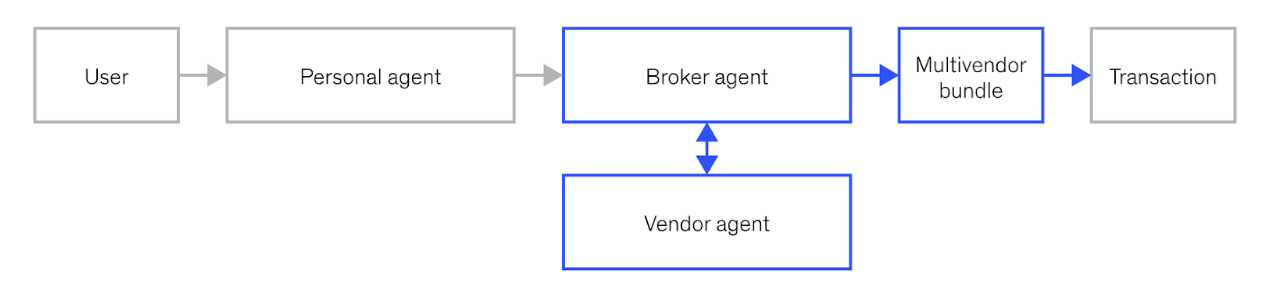
These models are part of a broader shift McKinsey highlights: the agentic era will provide a new channel that complements and combines the existing vertical, platform-specific journeys with a horizontal agent ecosystem that spans intents, channels, and contexts. Consumers will gain flexibility, no longer needing to jump between Amazon for shopping, Expedia for travel, or individual brand sites - personal agents will operate like full-service concierges, handling needs the moment intent appears.
Start Now
Kleio provides the framework to already start with Human-to-Agent today and evolve into full Agent-to-Agent communication tomorrow. This progression ensures your brand is ready when the ecosystem becomes fully connected.
Businesses can start immediately by integrating Kleio with their product catalogue. Once connected, your agent can represent your full inventory, understand product relationships, and surface the right items to users in real time.
Kleio can also function as a complementary or alternative search bar, such as an agentic interface that lets customers dialogue with your catalogue rather than scroll through it. This conversational layer captures nuances that traditional filters cannot, revealing intent, preferences, and unmet needs.
By starting now, brands unlock a powerful feedback engine: the searches customers perform, the patterns the agent understands well, the queries it struggles with, gaps in the catalogue, and signals of product interest. These insights form the baseline for refining your data, improving your catalogue structure, and preparing your systems.
This preparation becomes a long-term advantage. When discoverability is solved - a matter of months - and agents begin talking to each other natively, your brand’s agent will already be trained, accurate, and ready, saving time and placing you ahead of competitors still racing to catch up.
The Discoverability Challenge and Our Perspective
One of the biggest barriers today is that most agents operate in closed systems. They cannot easily find, identify, or talk to each other. This lack of discoverability limits the pace of innovation and slows down adoption. Open standards such as the Model Context Protocol (MCP) and the A2A framework are being developed to fix this by defining how agents exchange information across platforms.
At Kleio, we believe that major players such as ChatGPT and others must prioritize discoverability and open standards. The early internet faced a similar limitation before Google made information searchable. Once discoverability becomes universal for agents, the full potential of Agentic Commerce will unfold.
This moment feels strikingly similar to the early internet era, when thousands of websites existed but remained hidden in plain sight. Before the rise of search engines, the web’s true value was limited by its inaccessibility. Once discoverability was solved, an entire digital economy emerged almost overnight. The same evolution is now happening with AI agents. As protocols mature and indexing systems for agents become mainstream, a connected and intelligent ecosystem will take shape.
When that happens, the companies that have already built their agent infrastructure will hold a decisive advantage. They will be the first to integrate, collaborate, and transact within this new environment while others rush to catch up. Now is the moment to lay that foundation, because once the ecosystem connects, speed and readiness will define who leads and who follows.
This shift also transforms marketing. The competition will no longer be for clicks or impressions but for relevance inside conversational ecosystems. Search Engine Optimization will evolve into Generative Engine Optimization, where brands aim to become the preferred choice within AI models and agent networks. Marketing will move from one-time outreach to continuous collaboration between intelligent systems that interpret user needs and deliver tailored results.
Another major shift predicted as AI agents evolve toward agentic commerce communication is that traditional marketplaces will lose their central role. Instead of relying on platforms to connect buyers and sellers, AI agents will communicate directly, comparing listings, negotiating terms, and finalizing transactions autonomously. In real estate, this means a buyer’s agent could instantly exchange data with a seller’s agent to match preferences, check availability, and even prequalify leads without human or platform mediation. The result is faster, trust-based interactions where value flows seamlessly between agents rather than through intermediaries.
Start Now with Kleio
Now is the moment to build your agent infrastructure. The data you collect through Human-to-Agent interactions today will form the foundation for tomorrow’s Agent-to-Agent ecosystem. Early movers will gain the advantage of stronger personalization models, faster learning cycles, and seamless integration once agents across industries begin communicating.
What Kleio Does
Kleio builds intelligent, industry-specific AI agents that help businesses move to Agentic Commerce. Our agents don’t just chat - they understand, recommend, and act. Powered by our proprietary Knowledge Engine and real business data, Kleio connects directly to your systems to deliver real outcomes such as product recommendations, quote generation, bookings, and sales.
Kleio already powers AI agents across travel, real estate, cosmetics, automotive, and energy. Each agent learns from your workflows, understands your products, and personalizes every interaction to turn conversations into conversions.
How Kleio Works
Each Kleio agent is trained on your real business context. It connects to your CRM, ERP, and catalog data, then uses that knowledge to handle complex user journeys, helping, advising, and closing the loop on actions that normally require human input. As inter-agent connectivity evolves, these same agents will be able to negotiate with other business agents, exchange data, and complete transactions on your behalf.
Get in Touch
The future of commerce belongs to brands whose agents can think, talk, and act. Start building yours now. With Kleio, you can move from simple chat to intelligent conversation, from support to sales, and from Human-to-Agent-to-Agent. Book a call with our co-founder to learn more about how we can support you. https://calendly.com/adrien-kleio