

.png)
The rise of AI and its rapid adoption is profoundly disrupting how consumers search for and select products and services.
Previously, customers relied on search engines to locate products and then browsed corporate catalog websites or spoke directly with sales representatives who guided them through those catalogs. Traditional search channels (Google, …) dropped by 20% between 2024 and 20251 and is expected to drop by 25%2 by the end of 2026. Potential customers will increasingly rely on AI assistants (such as ChatGPT, Gemini, or Claude, traffic +693% YoY at holidays in the US3) to identify the types of products that best meet their needs. These insights pave the way brands work on their GEO (Generative Engine Optimization).
As the number of users relying on AI assistants grows - as we believe it inevitably will - the challenge of reaching these users becomes increasingly critical. To address this, new protocols have been developed to enhance "AI chatbot" capabilities, transforming them into true agents.
The Role of MCP servers
Initially, it became possible to grant AI assistants access to "tools" that allow them to query external databases, use online services, or even execute actions in external systems. A key example of this is the MCP (Model Context Protocol). This protocol is an emerging standard for connecting AI applications (or LLMs) to external systems, often referred to as an “USB-C port for AI applications”. MCP servers are an evolution of existing API standards (REST, etc.) designed for LLMs because in addition to providing functions and resources that can be called, they also publicly declare those in a format suitable for LLMs; therefore, enabling AI Applications to autonomously decide when and how to call those resources.
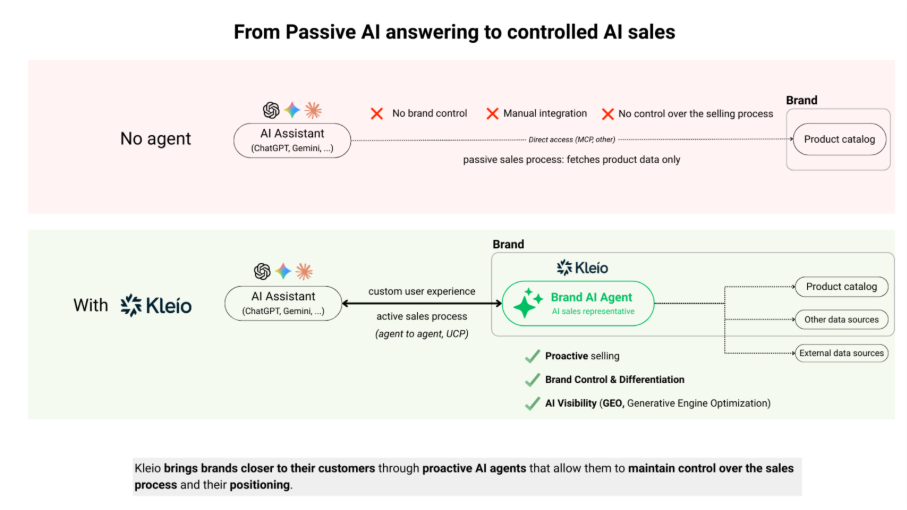
In a sales context, a typical MCP server will provide access to the raw catalog that a buyer’s personal assistant will then query based on its understanding of the user’s needs.
Connecting a generic agent or a personal assistant to such a server could be tempting but it makes the selling company lose control over critical elements, such as:
- Which offers are prioritized (based on their own business strategy).
- Which sales arguments are emphasized.
- How their unique brand identity and value propositions are communicated.
In this scenario, the quality of the sale rests entirely on a third-party agent that is technically serving the buyer.
We believe this approach is insufficient. First, because a catalog-based MCP server lacks inherent intelligence, it essentially hands over the entire sales process to the buyer's AI agent. But also, because today, adding a MCP server to a personal AI agent is a manual process (from the user).
Kleio Specialized Agents
The Kleio agents and our proprietary methodology allow us to configure specialized sales agents that truly represent the brand. They not only integrate the catalog, but also the company’s specific sales priorities and strategies, and third-party data sources.
While catalog-based MCP servers are passive, generic tools, and often difficult for a standard personal assistant to use without complex configuration, Kleio agents are proactive, optimized, and consistent with your brand image.
Standards for agent-to-agent interaction are currently being established and are paving the way for a more sophisticated digital economy in which Kleio takes a critical role by ensuring brands’ interests.
On top of the MCP and agent-to-agent, initiatives are globally launched to standardize agentic commerce: Google has started the UCP (Universal Commerce Protocol), and OpenAI the ACP (Agentic Commerce Protocol). The UCP seems very promising as an open ecosystem in which selling companies can provide their own agents to tackle critical parts of the tunnel, like product recommendation and offer construction.
In this landscape, Kleio’s expertise in building high-performance sales agents is essential for any company aiming to master GEO. We believe that future market share will depend on agent affinity: the ability of a brand’s AI to provide the structured, reliable, and persuasive interactions that lead buyer agents to prioritize one brand over another.